Software trends are easy to list and hard to act on. This guide covers the seven that matter most to businesses commissioning or running software in 2026, with a plain explanation of what each means and what to do about it.
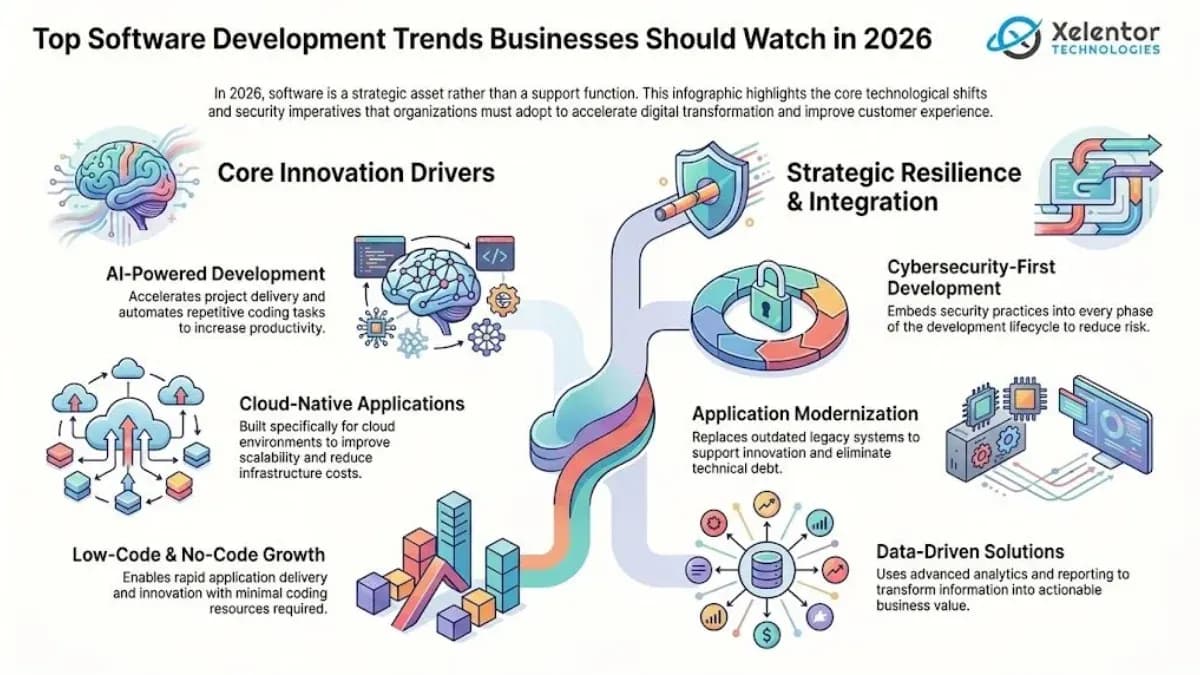
AI-assisted development
AI tools now help engineers write code, generate tests, review changes and write documentation. This speeds up routine work. It does not remove the need for people to design the system, make security decisions and review what is shipped.
What to do: ask any vendor how they use AI in their process, how the output is reviewed and how your code and data are protected.
AI inside business software
The bigger shift is AI as a feature: search that understands questions, assistants that summarize documents, tools that classify and route requests. Many businesses can add these capabilities to the software they already run through APIs rather than rebuilding.
What to do: pick one repetitive, measurable workflow and prove the value on real examples before scaling. See how to integrate AI into existing business software.
AI agents and workflow automation
Agents go beyond answering questions. They can use connected tools to complete multi-step tasks, with people approving the decisions that matter. They work best on well-defined processes with clear limits on what they may do.
What to do: combine agents with ordinary automation for predictable steps and keep a person in the loop. Read AI agents vs traditional automation for how to choose.
Security built in from the start
Security is moving earlier in the process. Teams now check dependencies, scan code and review access during development instead of at the end. Customers and regulators increasingly ask how software is secured.
What to do: ask how security testing fits into delivery and make sure access to your data is limited to the people who need it.
API-first and connected systems
Businesses run many tools that need to share data. Designing APIs first makes it easier to connect systems, add new channels and replace parts without rebuilding everything.
What to do: treat integrations as part of the design, not an afterthought. See what API-first development means.
Cloud-native and modernization
Older systems that cannot connect, scale or adopt AI are a growing constraint. Many businesses modernize in phases, moving the most limiting parts first while keeping operations running.
What to do: assess which systems limit you most and choose between upgrading, rebuilding and replacing. Our guide to upgrade, rebuild or replace explains how.
Low-code with governance
Low-code and no-code tools let business teams build simple internal apps quickly. They suit straightforward workflows. They need rules about who can build what, where data lives and when a tool should graduate to custom software.
What to do: use low-code for simple internal needs and custom software for core products, complex logic and anything customer-facing.
How to prepare
- List your systems and rank them by how much they limit the business
- Pick one or two trends that match real problems instead of chasing all of them
- Run a small, measurable pilot before a large investment
- Ask your technology partner how each trend fits your roadmap and budget
- Review the plan every few months, because tools change quickly
Conclusion
The useful question is not which trend is biggest but which one solves a problem you have today. Start with one clear use case, measure the result and build from there.
Frequently asked questions
What are the biggest software development trends in 2026?
AI-assisted development, AI inside business software, AI agents and automation, security built in from the start, API-first design, cloud-native modernization and governed low-code are the main ones.
How is AI changing software development?
AI tools speed up routine coding, testing and documentation. AI features are also being added to business applications. People still make the design, security and review decisions.
Should my business use low-code platforms?
They suit simple internal workflows. Core products, complex logic and customer-facing systems usually need custom software.
Where should a business start with these trends?
Pick one workflow or system where the pain is clear and the result can be measured. Run a small pilot, then expand if it works.