Every founder believes their software idea has potential.
The challenge is knowing whether the market agrees before investing significant time and money into development.
Many start-ups and businesses move directly into building products without validating whether the problem is important enough for customers to actually pay to solve. That often leads to wasted budget, delayed launches and products that struggle to gain traction.
Before committing to development, product validation helps answer one critical question:
Is this software worth building?
For start-ups and growing businesses, validating early reduces risk, improves MVP planning and helps development become a strategic investment instead of an expensive guess.
Why product validation matters?
Software development involves significant investment in:
- Planning
- Design
- Engineering
- Testing
- Infrastructure
- Ongoing improvements
If market demand has not been validated first, even well-built software can fail commercially.
The biggest product risk is not poor code.
The biggest risk is building something users do not urgently need.
Validating your software idea before development helps you:
- Reduce unnecessary development costs
- Avoid building unused features
- Prioritize a smarter MVP
- Understand real customer pain points
- Improve product-market fit
For businesses, validation is not about slowing down.
It is about building with evidence instead of assumptions.
Start with the problem, not the features
One common mistake founders make is focusing on features too early.
Strong software products are usually built around problems that are:
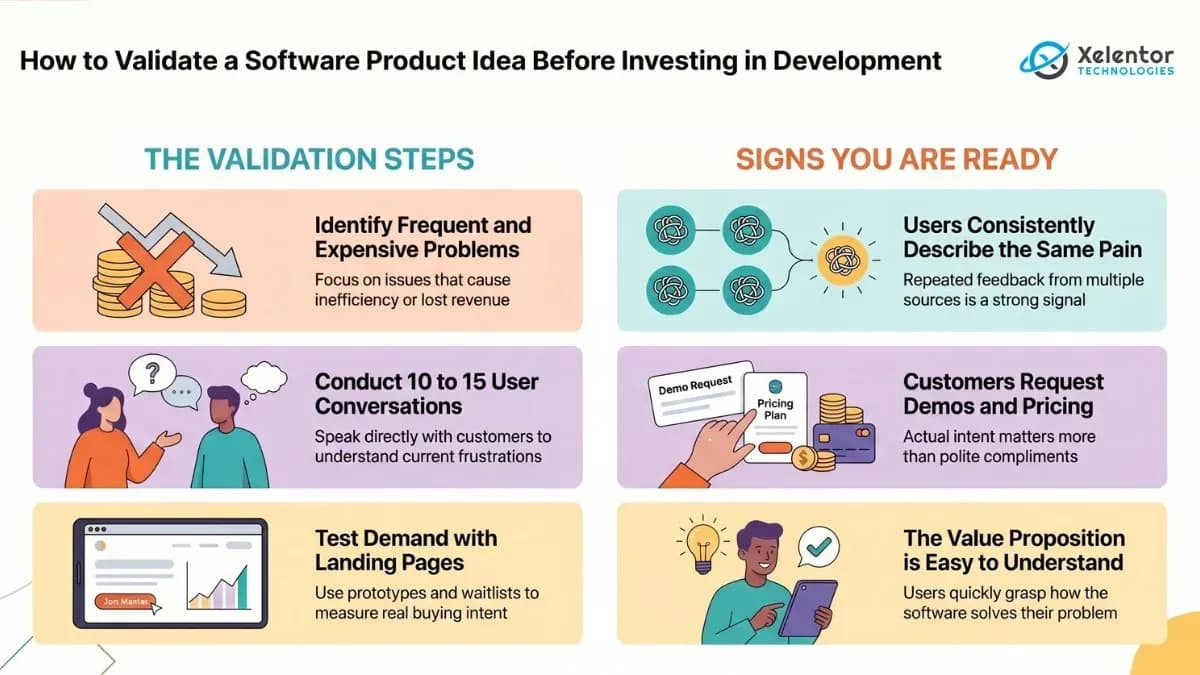
- Frequent
- Expensive
- Frustrating
- Currently solved poorly
Instead of asking "Would people use this product?" ask:
- Who experiences this problem?
- How often does it happen?
- What does it cost the business?
- How are companies solving it today?
If the problem is minor, users are unlikely to switch solutions.
If the problem creates operational inefficiency, compliance risk, lost revenue or wasted time, the market opportunity becomes much stronger.
Talk to real users before writing Code
Before building software, speak directly with potential customers.
This step alone can save months of unnecessary development.
Instead of pitching the solution immediately, focus on understanding current workflows and frustrations.
Ask questions such as:
- How do you currently solve this problem?
- What frustrates you about the existing process?
- How often does this issue affect your business?
- Have you paid for a solution before?
These conversations reveal whether the pain point is genuinely important.
For many start-ups, 10 to 15 conversations with the right users provide more valuable direction than weeks of internal brainstorming.
Test demand before full development
You do not need to build a complete product to validate demand.
Early validation can be done using:
- Landing pages
- Clickable prototypes
- Waitlists
- Demos
- Pilot discussions
The goal is not simply generating traffic.
The goal is measuring real buying intent.
Strong validation signals include:
- Demo requests
- Qualified sign-ups
- Pricing discussions
- Requests for early access
- Pilot conversations
These actions matter far more than compliments like:
“This sounds interesting.â€
Example: why validation changes product direction
Imagine a start-up planning contractor management software.
Initially, the founders believe onboarding automation is the biggest pain point.
However, after speaking with businesses, they discover the larger challenge is actually:
- Document expiry tracking
- Audit preparation
- Compliance visibility
Without validation, the company may spend months building the wrong priorities.
With validation, the MVP becomes more focused, commercially relevant and easier to sell.
Signs your idea is ready for development
Your software idea is usually more ready for development when:
Users consistently describe the same problem
Repeated feedback from multiple potential customers is a strong signal.
The value proposition is easy to understand
If users quickly understand what the software solves, positioning becomes easier.
There are signs of buying intent
Demo requests, pilot discussions and pricing conversations indicate real market potential.
MVP scope becomes clearer
Validation helps separate essential functionality from unnecessary complexity.
At this stage, you are no longer building based on assumptions.
You are building around evidence.
Common validation mistakes
Building too early
Starting development before validation often creates expensive rework later.
Focusing on features instead of outcomes
Customers care more about outcomes than feature lists:
- Saving time
- Reducing risk
- Improving efficiency
- Lowering operational costs
Taking feedback only from friends or internal teams
Friends and colleagues tend to be polite. Real prospects will tell you whether the problem is worth paying to solve.
Confusing interest with willingness to pay
A stronger signal is someone asking "How much does it cost?" rather than saying "That sounds useful."
Why validation improves development efficiency
Validation does more than reduce business risk.
It also makes software development more efficient.
When product direction is clear, development teams can:
- Define scope faster
- Reduce feature waste
- Estimate timelines more accurately
- Avoid unnecessary pivots
- Launch leaner MVPs
For start-ups, this helps protect runway and improve capital efficiency.
For businesses, it leads to smarter technology investment decisions.
Final thoughts
A software idea does not need to be perfect before development.
But it should be validated.
The businesses that validate early often move faster later because they better understand:
- The users
- The problem
- The business impact
- The market demand
Before investing heavily in software development, make sure the market is giving strong signals that the problem is worth solving.
That is one of the most effective ways to reduce risk and improve the chances of building software people genuinely want.
Frequently asked questions
How do I validate a software product idea without building it?
You can validate a software idea through customer interviews, landing pages, prototypes and by measuring real buying intent such as demo requests or qualified sign-ups.
How many users should I talk to before starting development?
For early-stage validation, conversations with 10 to 15 relevant users are often enough to identify recurring pain points and demand patterns.
What is the fastest way to validate software demand?
A landing page with a clear value proposition and CTA such as booking a demo or requesting early access is one of the fastest validation methods.
Should start-ups build an MVP before validation?
Usually, start-ups should validate the problem first. Once there are strong signals that customers care about the solution, building an MVP becomes a smarter next step.