Sooner or later every growing company asks the same thing: do we buy a ready-made product or build our own?
It is an easier question to answer than it looks, once you are honest about two things. How different is the way you work from everyone else's? And how much does that difference matter to the business? This guide walks through the trade-offs so you can answer both.
Custom software is built around your own workflows and goals. Instead of fitting your business to a product, the product is shaped to fit you. It connects to the systems you already use.
Benefits of custom software development
- Designed for the way your business works
- Scales as your company grows
- Flexible when your needs change
- Security and compliance controls you can shape
- Connects to your existing systems
- Can become a real advantage over competitors
Growing companies often choose custom software because they want control over features, functionality and user experience.
Drawbacks of custom software
- Higher upfront cost than buying a ready-made product
- Longer time to launch because the software has to be designed and built
- Ongoing responsibility for maintenance, hosting and updates
- Needs clear requirements and a capable development team
What is off-the-shelf software?
Off-the-shelf software is a ready-made product built for many kinds of business. You sign up, set it up and start using it. Think of CRM systems, accounting software, project management tools and team collaboration platforms.
Benefits of off-the-shelf software
- Lower initial investment
- Faster deployment
- Regular vendor updates
- Large user communities and support resources
- Proven functionality
If your needs are standard, buying is often the sensible choice. There is no reason to build something that already exists and works well.
Drawbacks of off-the-shelf software
- Limited customization, so your workflows may have to adapt to the product
- License costs that grow with the number of users
- The vendor decides the roadmap and when features change
- Integrations with your other systems can be restricted
Custom software vs off-the-shelf software: key differences
Customization
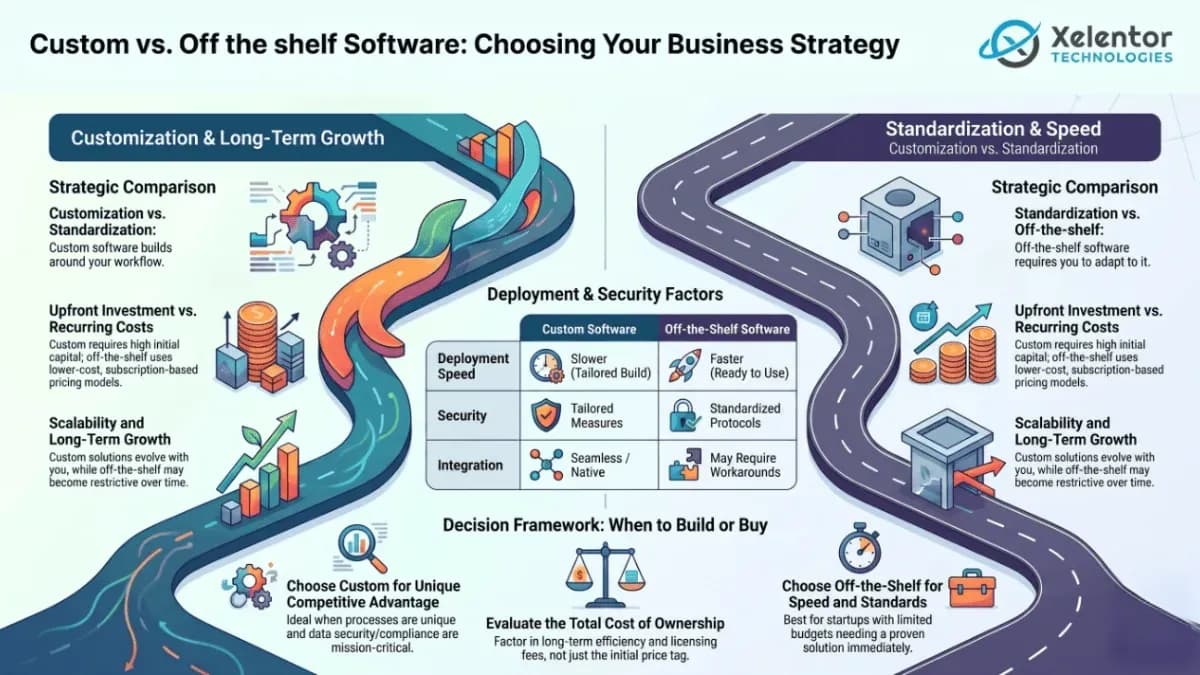
Custom software follows your processes. Off-the-shelf software gives you a set of options. You often change how you work to match it.
Cost
Off-the-shelf software costs less to start and is usually priced by subscription. Custom software needs a larger investment up front. Over several years it can come out ahead if it removes license fees and saves your team time, but that depends on how many users you have and how much manual work it replaces.
Scalability
Custom software is built to grow with you. A ready-made product can become restrictive as your needs change. You may end up paying for extra licenses, upgrades or add-ons.
Integration
Custom software can be built to connect to the systems you already run. With a ready-made product you may need extra tools or workarounds to get the same result.
Security
With custom software you decide which security measures and compliance controls to build in. A ready-made product follows standard protocols, which are often good but may not cover every risk in your business.
When should you choose custom software?
Custom software is usually the right choice when:
- Your business processes are unique
- Existing software cannot meet your requirements
- You need advanced integrations
- Scalability is a priority
- Data security and compliance are critical
- The software itself gives you an edge over competitors
The last point matters most. If the software is part of what makes your business different, it is usually worth owning.
When should you choose off-the-shelf software?
Off-the-shelf software is usually the right choice when:
- Your requirements are standard
- Budget constraints are significant
- You need a solution quickly
- Extensive customization is not required
- Your business is in the early stages of growth
Many companies do both. They buy standard tools for standard jobs, such as accounting and email. They build custom software only for the parts that set them apart.
How to choose the right software solution for your business?
Before you decide, work through these questions.
Business requirements
Write down your current processes, your pain points and where you want to be in a few years.
Budget
Compare the total cost of ownership over several years, not only the price on day one.
Future growth
Ask whether the software can keep up if you double your team or add a new product line.
Integration needs
Check how it will work with the tools you already use.
Security requirements
Note the compliance standards and data protection rules that apply in your industry.
Conclusion
The right answer depends on your goals, how complex your operations are and where you plan to be in a few years. Off-the-shelf software gives you low cost and a quick start. Custom software gives you flexibility, room to grow and a product shaped around how you work.
If your needs are standard, buy. If your processes are what make you different, build. If you are not sure, start with a ready-made tool and replace the parts that start to get in your way.
Frequently asked questions
Is custom software better than off-the-shelf software?
Custom software is better for businesses with unique requirements, scalability needs and complex workflows. Off-the-shelf software is suitable for standard business processes and faster deployment.
What are the advantages of custom software development?
Custom software offers greater flexibility, scalability, security and alignment with business objectives compared to generic software solutions.
Is custom software more expensive?
Custom software generally requires a higher initial investment, but it can provide better long-term value through improved efficiency and reduced dependency on third-party tools.
How do I know if my business needs custom software?
If your current software creates workflow limitations, lacks essential features or cannot scale with your growth, custom software development may be the right solution.