There is no standard price list for custom software. Two projects that look alike on paper can cost very different amounts, because price follows effort and effort follows scope, complexity and the team you need.
This guide explains how custom software is priced, what moves the number, what is easy to forget and how to compare quotes without surprises.
If you want a rough range for your own project first, try our project cost estimator. It shows a price range, timeline and team size as you answer a few questions.
How custom software is priced
Every quote comes down to the same idea: the effort needed to build the product multiplied by the cost of the people doing the work. What changes is how that cost is agreed. There are three common models.
| Model | How it works | Best for | Watch out for |
|---|---|---|---|
| Fixed price | A set fee for an agreed scope | Clear requirements and a defined first release | Changes need a formal change request and some vendors add a contingency to cover risk |
| Time and materials | You pay for the effort actually used | Evolving requirements and early-stage products | Needs close tracking and an agreed budget cap |
| Dedicated team | A monthly fee for a team that works only on your product | Long-running products and changing priorities | Works best when you can set priorities every week |
What drives the cost
These factors have the biggest effect on the final figure.
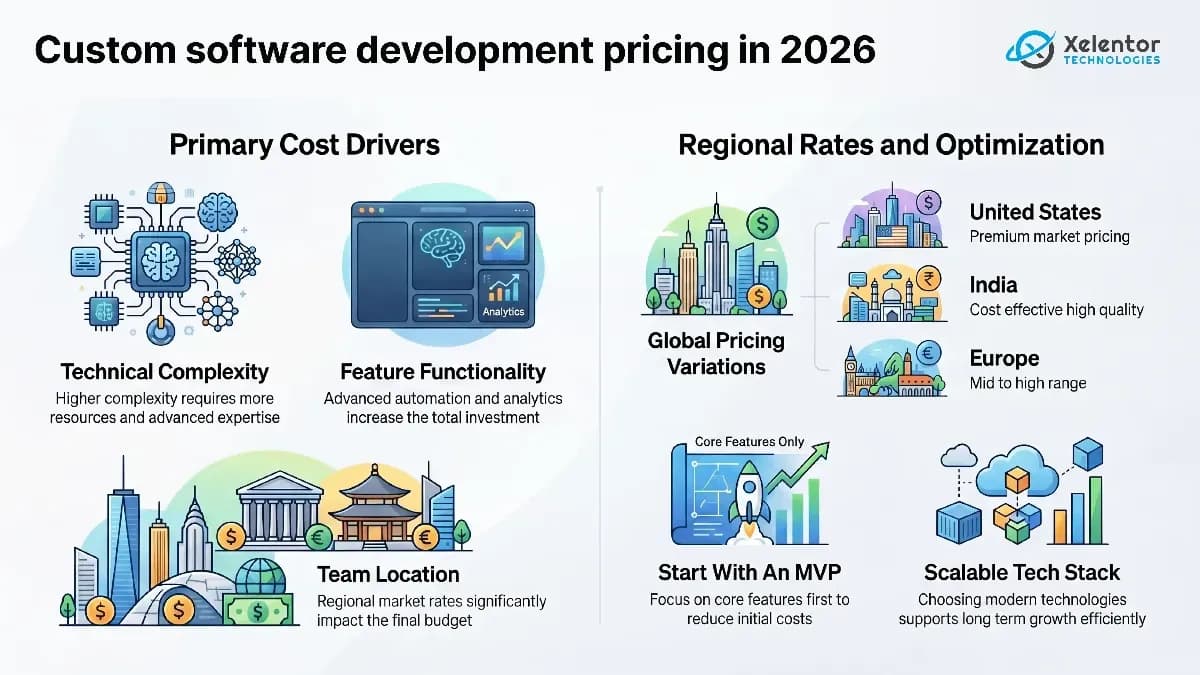
Scope and features
Each feature adds design, build and testing work. A login and a dashboard cost far less than payments, roles and permissions, reporting and workflow rules.
Platforms
A web app is one build. Adding iOS and Android apps adds more, although a cross-platform approach can share much of the work.
Integrations
Every system the software must talk to, such as a CRM, payment provider or legacy database, needs design, testing and ongoing support. Poorly documented systems cost more to connect.
Design
A standard interface built from proven patterns costs less than a fully custom design system with research and prototyping.
Security and compliance
Regulated industries and sensitive data call for extra design, testing and documentation. It is cheaper to plan for these rules at the start than to add them later.
Team and timeline
Senior engineers cost more per hour but often finish sooner and make fewer mistakes. A tight deadline usually needs a bigger team, which raises the cost.
What a budget should include
A complete estimate covers more than writing code.
- Discovery and planning, to settle scope before building
- UI/UX design
- Development
- Quality assurance and testing
- Deployment and DevOps
- Project management
- Support and maintenance after launch
Costs that are easy to forget
- Hosting and cloud services, which are billed monthly
- Third-party licenses and API fees
- App store fees for mobile apps
- Ongoing maintenance, updates and security patches
- Data migration from an older system
- Training and the time your own team spends on the project
Ask any vendor which of these are included and which are billed separately.
Why hourly rates can mislead
Rates differ by region and by the experience of the team. A lower hourly rate does not always mean a lower total cost. Unclear requirements, weak testing and rework can erase the saving, so compare the total scope and the quality of the process as well as the rate.
How to compare quotes
Quotes are only comparable when they cover the same scope. Before you decide, check each one for the following.
- What is included and what is not
- The assumptions behind the estimate
- How changes to scope are handled and priced
- Who owns the code from the first day
- How payments are tied to milestones
- What support is offered after launch
- The roles on the team and their experience
A quote that is much lower than the others usually leaves something out. Ask what.
Ways to keep cost under control
- Start with a short discovery phase so the scope is clear before the build starts
- Launch a focused first version and add features based on real use
- Rank features so the most valuable work is done first
- Release in phases and review the budget after each one
- Use AI-assisted engineering for repetitive work, while keeping people responsible for design, testing and security
A discovery workshop is a practical way to turn an idea into a defined scope and a more reliable estimate.
Conclusion
Pricing for custom software is not mysterious once you know the parts. Effort, team and pricing model decide the number. A clear scope keeps it stable. Compare quotes on what they include rather than on the headline figure alone.
Frequently asked questions
How much does custom software development cost?
It depends on scope, platforms, integrations, design, compliance needs and the team. A small focused first release and a large multi-system platform can differ by a very large factor. Use our project cost estimator for a first range, then confirm it with a written estimate.
Should I choose a fixed price or time and materials?
Fixed price suits projects with clear requirements and a defined scope. Time and materials suits products that will change as you learn. Many projects start with a fixed-price discovery phase and then move to a flexible model.
How long does it take to build custom software?
Timelines depend on scope and team size. A focused first release usually takes a few months. Larger platforms are delivered in phases over a longer period.
Why do quotes for the same project differ so much?
Vendors may assume different scope, team seniority, testing effort or support. Ask each vendor to list what is included and what is excluded so you can compare like with like.
Is maintenance included in the price?
Usually not. Hosting, updates, security patches and support after launch are typically quoted separately, so ask about them when you compare quotes.