Most software now has to talk to other software: a website, a mobile app, a payment service, a CRM, a partner's system. If those connections are bolted on at the end, they are usually awkward, inconsistent and expensive to change.
API-first development turns that around. You design the API first and the applications are built around it. This guide explains what that means, what it gives you and where it fits best.
What is API-first development?
API-first is a way of building software in which the APIs are designed, documented and agreed before the application is built. Instead of creating an application and adding an API later, the team writes down exactly how the pieces will communicate and then builds to that agreement.
Because the contract is clear, frontend, backend and third-party teams can work at the same time. It is widely used for cloud applications, enterprise software, mobile apps and SaaS products that need to connect to several systems.
Why API-first development matters?
A single company may run a CRM, an ERP, payment gateways, marketing tools, analytics and several cloud services. Connecting them one at a time gets messy quickly. API-first creates a standard way for all of them to communicate, so you build a connected platform and not a pile of isolated tools.
It also means you can add new technology later without disrupting what already works.
Benefits of API-first development
Faster software development
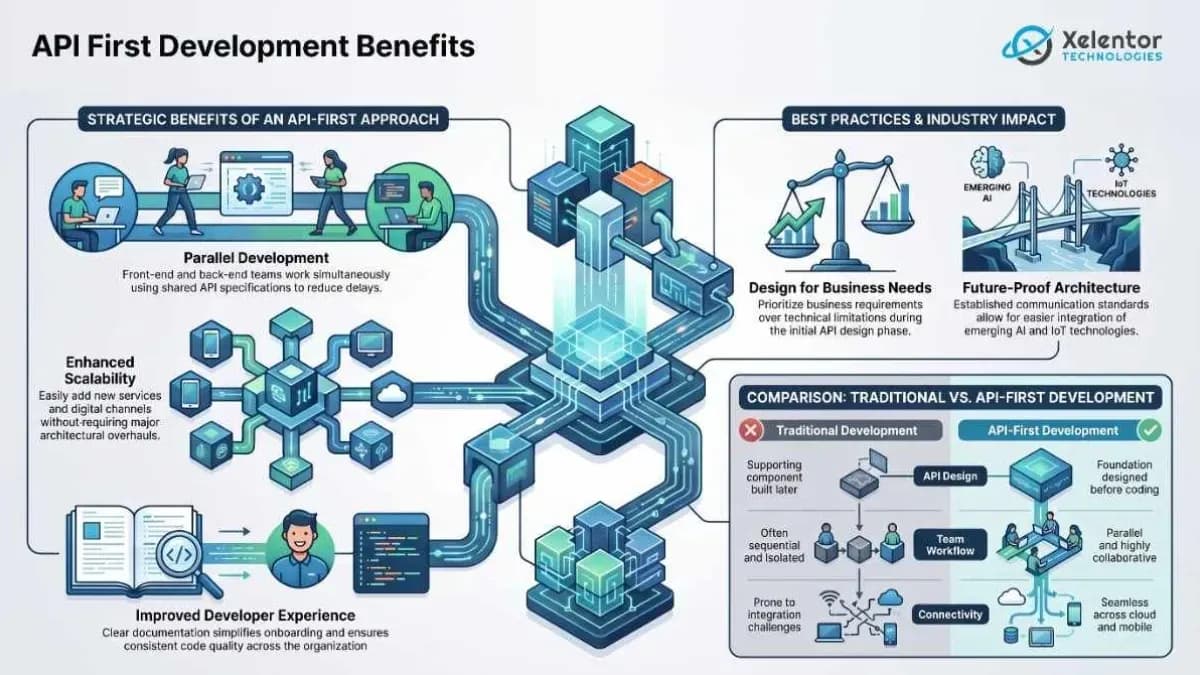
Once the API is agreed, the frontend and the backend can be built independently against the same specification. That removes waiting between teams and shortens the schedule.
Improved collaboration
Developers, testers, designers and business stakeholders all work from the same API documentation, so there are fewer misunderstandings and less rework.
Better integration
Customer portals, mobile apps, payment gateways, ERP and CRM systems and third-party services all connect more easily and data stays consistent across them.
Enhanced scalability
New services, integrations and channels can be added without large architectural changes, which keeps future development cheaper.
Improved developer experience
Clear documentation lets developers understand the system before they write code. New team members get up to speed faster and the code is more consistent.
Future-proof application development
Whether the next step is a new cloud platform, an AI feature or a connected device, an application with a clean API is far easier to connect.
API-first development vs. traditional development
In traditional development the API is often an afterthought, created once the application works. That is fine for a simple system and becomes a source of trouble as the number of integrations grows. API-first reverses the order. The API is designed first, so every system follows the same standards and is ready for whatever you connect later.
Industries benefiting from API-first development
- Financial services: secure payments and digital banking.
- Healthcare: patient management systems, health records and telemedicine platforms.
- Retail: online stores, inventory systems and loyalty apps.
- Manufacturing: production systems, supply chain platforms and connected devices.
In every industry the benefit is the same: a connected set of systems that works for staff and customers.
Best practices for API-first development
Design the API around business needs and not around technical convenience. Document it clearly, use version control, require strong authentication and test thoroughly. Then monitor performance and set clear rules on who can change what, so integrations stay consistent as the platform grows.
Conclusion
API-first development is a practical way to build software that connects well and keeps connecting as you grow. Decide how the pieces will talk before you build them and your teams, your integrations and your future plans all get easier.
Frequently asked questions
What is API-first development?
API-first development is a software development approach where APIs are designed and documented before application development begins, ensuring consistent communication between systems and improving scalability.
Why is API-first development important?
API-first development simplifies integration, accelerates software delivery, improves collaboration and creates applications that are easier to maintain and expand.
What are the benefits of API-first development?
Key benefits include faster development, improved system integration, enhanced scalability, better collaboration, future-ready architecture and a better developer experience.
Which businesses should adopt API-first development?
Organizations developing cloud applications, enterprise software, SaaS platforms, mobile applications or systems requiring multiple integrations can benefit significantly from API-first development.
How does API-first development support digital transformation?
API-first development enables businesses to connect applications, automate workflows, integrate emerging technologies and build flexible software that adapts to changing business requirements.