An application that works for today's users is the easy part. The real test comes when the business doubles, adds a new product line or connects to five more systems. If the software was not built with that in mind, the fix is usually an expensive rebuild at the worst possible time.
Scalability is about more than handling traffic. It means software that stays fast, secure and easy to change as the business grows. This guide covers the decisions that matter most.
What is a scalable enterprise application?
It is a system built to cope with more users, transactions and data without slowing down, failing or becoming impossible to maintain. A scalable application typically has:
- Steady performance as demand grows
- Efficient use of resources
- A modular, maintainable structure
- Easy connections to other systems
- High availability and tolerance for failure
- Room for new business requirements
Why scalability matters for business growth?
Growth puts pressure on technology. A successful application may need to serve thousands of users at once, process millions of transactions and connect with many third-party platforms. Without a scalable design you see slow screens, outages, rising infrastructure costs and delayed features and those hurt customers and staff alike.
Building for scale early costs much less than re-engineering later.
Start with a clear business and technical strategy
Begin with what you expect to happen: user growth, transaction volumes, integrations, regulatory needs and performance targets. That tells the team which technologies to choose and which complexity to leave out. Scale for the growth you can reasonably foresee, not for every possible future.
Choose the right application architecture
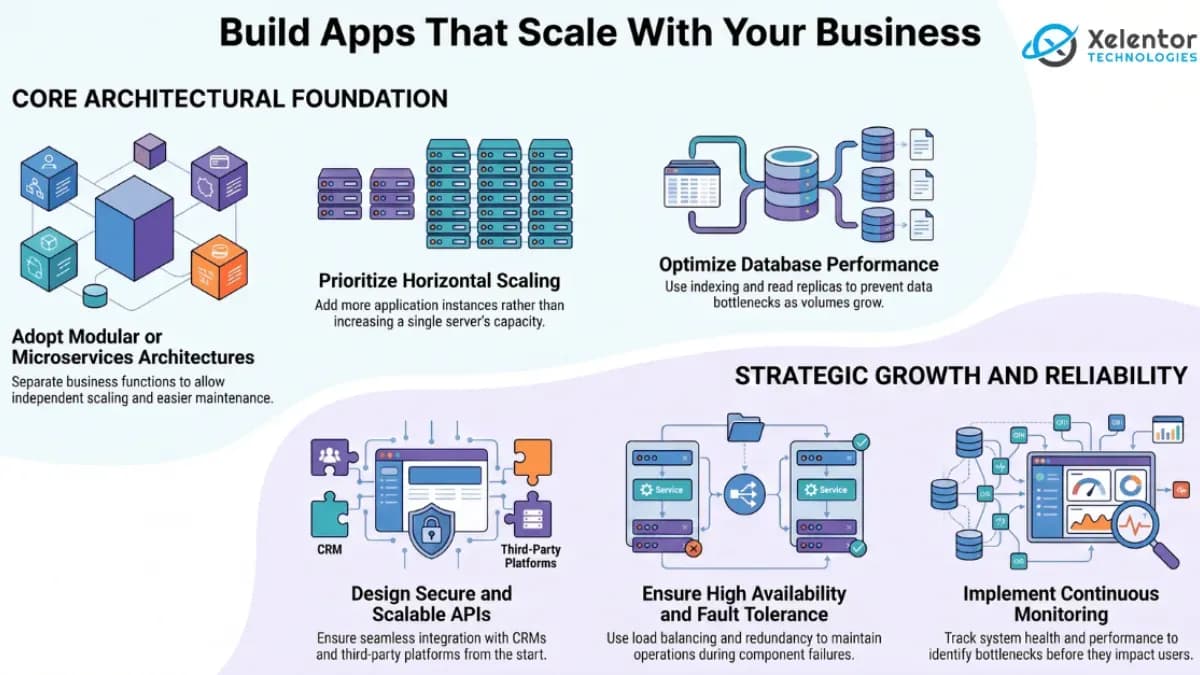
Architecture is the foundation. A single monolithic application can be perfectly fine for a smaller system. As an enterprise system grows, a modular design lets you update, test and scale one area without touching the rest. Separate concerns such as authentication, billing, reporting and inventory into distinct parts.
Microservices are one option, not a requirement. The right choice depends on complexity, your team's experience and how fast you expect to grow.
Design for horizontal scalability
Horizontal scaling means adding more instances of the application instead of making one server bigger. It gives you better fault tolerance and flexibility. To make it work, keep local server state to a minimum, manage sessions in a shared way and store shared data where every instance can reach it. This matters most for cloud and container-based systems.
Optimize database architecture
The database is where many systems hit their first wall. Good indexing, optimized queries, read replicas for reporting, partitioned large tables, caching and constant monitoring of slow queries keep it healthy. For very large datasets or special workloads such as search or analytics, a purpose-built data store may be worth considering.
Implement efficient caching strategies
Caching stops the system fetching the same data again and again. Used at several levels, from application data to database queries, it improves response times and lets the same hardware serve more people.
Build secure and scalable APIs
Enterprise systems rarely stand alone. They connect to CRMs, ERPs, payment services, mobile apps and analytics tools. Design the APIs early, with proper authentication and authorization, rate limits, versioning, documentation and monitoring. Good APIs let you add systems without breaking the ones already in use.
Prioritize performance from the beginning
Performance is easier to build in than to bolt on. Set performance targets, design efficient data access, run long tasks in the background and keep frontend assets light. Problems found late are expensive to fix once the system is large.
Ensure high availability and fault tolerance
If the application runs critical operations, it has to keep running when a part fails. That usually means load balancing across instances, redundancy across zones or regions, automatic failover, health checks, backups and a tested recovery plan.
Adopt DevOps and CI/CD practices
Scalability is also about how quickly and safely you can change the system. Automated builds, automated tests, infrastructure defined as code and consistent environments make releases smaller, safer and more frequent as the application grows.
Monitor and measure continuously
You cannot manage what you cannot see. Watch application performance, infrastructure health, database speed, API response times, error rates and security events, along with business measures such as transaction success. Good monitoring spots bottlenecks early and guides capacity planning.
Plan for future technology evolution
Today's technology choices will need to change. Modular design, standard APIs and cloud-native principles make it easier to adopt new cloud services, AI features and security tools later without a rewrite.
Common mistakes to avoid
- Tightly coupling components so that one change breaks another
- Doing everything synchronously, including slow tasks
- Ignoring database performance until it is a crisis
- Underestimating monitoring
- Designing only for today's traffic
- Over-engineering for scale you may never reach
Conclusion
Scalable software comes from clear planning, sound architecture, attention to performance and security and steady operational care. It is not a feature you can add at the end. Teams that treat it as part of the design from day one can grow without the disruption of a rebuild.
Frequently asked questions
What is a scalable enterprise application?
A scalable enterprise application is a software system designed to handle increasing users, transactions, data volumes and business complexity while maintaining performance, reliability, security and maintainability.
Why is scalability important for enterprise applications?
Scalability allows enterprise applications to support business growth, improve performance under higher workloads, reduce operational disruptions and avoid costly architectural redesigns as the organization expands.
What architecture is best for scalable enterprise applications?
The best architecture depends on the application's complexity and business requirements. Modular and microservices-based architectures are often preferred for large-scale enterprise systems because they support independent scaling, deployment and maintenance of different business functions.
How can databases affect application scalability?
Poor database design can become a major performance bottleneck. Proper indexing, query optimization, caching, replication, partitioning and continuous performance monitoring are essential for maintaining scalability as data volume grows.
What role does cloud computing play in enterprise application scalability?
Cloud computing enables organizations to scale infrastructure resources dynamically, improve availability, reduce hardware management overhead, support distributed deployments and adopt modern cloud-native architectures that are optimized for scalability and resilience.