Software that has not been tested properly fails in front of the people you least want to see it fail in front of: customers, regulators and your own staff. The failure can be a security hole, a slow page, lost data or a workflow that quietly does the wrong thing.
Testing used to be a final step before release. In modern development it runs alongside the build from day one. This guide explains why testing matters, the main types and the practices that make it work.
What is software testing?
Software testing is checking that an application does what it should, performs well and stays reliable under different conditions. It finds bugs, performance problems and security weaknesses before your users do.
The point is not only to find defects. It is to make sure the software gives a consistent, dependable experience and supports the business goals it was built for.
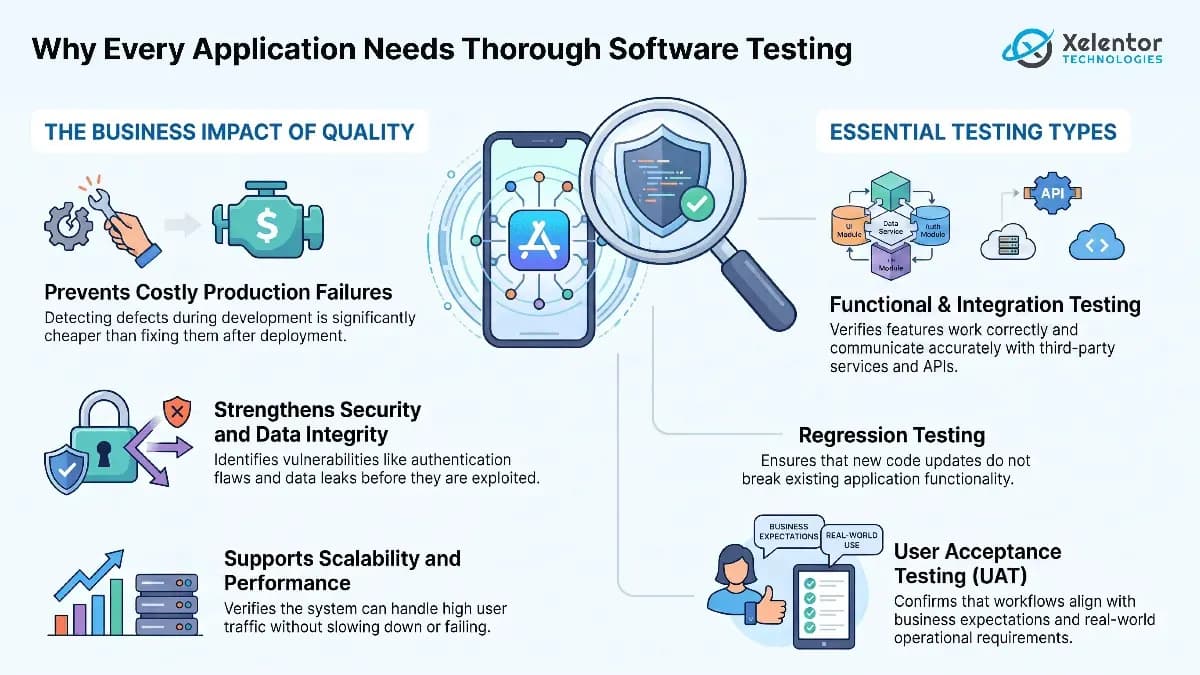
Why thorough software testing matters?
A defect found after release costs far more than one found during development. Thorough testing catches issues early and reduces rework, downtime and emergency fixes.
Improves user experience
People expect software to be fast, stable and clear. Testing checks that features work, screens behave the same way each time and performance holds across devices and environments.
Strengthens security
Weak authentication, missing authorization checks and unvalidated input can expose customer and business data. Security testing finds these before an attacker does.
Supports scalability and performance
As traffic grows the application must keep up. Load and performance testing show whether it can handle the workload you expect without slowing down or failing.
Builds business confidence
Tested software means calmer releases. Stakeholders, customers and your own team can trust that a new version will behave.
Key types of software testing
Functional testing
Checks that features work as the business requires, looking at inputs, outputs and workflows from the user's point of view.
Integration testing
Checks that the application works correctly with APIs, databases, payment gateways and other services and that data moves between them accurately.
Performance testing
Measures response times, throughput and stability under normal and peak load.
Security testing
Looks for weaknesses that could harm confidentiality, integrity or availability, including authentication, authorization, session handling and data protection.
Regression testing
Makes sure new changes do not break what already worked. It matters most for products that change often.
User acceptance testing
Real users or business stakeholders confirm that the software supports their workflows and is ready for production.
Common software testing challenges
Teams most often run into too little test coverage, tight deadlines, test environments that do not match production and poor communication between developers and testers. Relying only on manual testing is another common problem, because it cannot keep pace with frequent releases in Agile and DevOps teams.
Best practices for effective software testing
Start testing early
Begin in the requirements and design stages, not after development ends. Issues found early are the cheapest to fix.
Combine manual and automated testing
Manual testing is best for exploring the product and judging usability. Automation handles repetitive checks, regression suites and continuous integration.
Maintain clear test cases
Written test cases keep testing consistent between releases and make teamwork easier.
Test real-world scenarios
Use conditions close to production, with realistic user behavior, network conditions and data volumes.
Continuously monitor quality metrics
Track defect rates, coverage, performance and release stability so you can see trends and improve over time.
The role of automation in modern testing
Automation has become essential when teams release often. Automated tests run many cases quickly and the same way every time, which cuts human error and speeds up feedback. Connected to a CI/CD pipeline they flag a defect minutes after the code that caused it.
Automation should complement manual testing, not replace it. Exploratory and usability testing still need a person. AI tools now make it cheaper to write tests alongside each feature, which helps keep quality from slipping under deadline pressure.
Software testing and business growth
Stable, secure and fast software keeps customers and avoids costly outages. For any custom software, SaaS or enterprise application, a good testing strategy is how the investment keeps paying off as the business grows.
Conclusion
Testing is a basic part of building software that people can rely on. Combine functional, integration, performance, security and regression testing with sensible automation and you get applications that behave in the real world and keep supporting growth.
Frequently asked questions
What is software testing?
Software testing is the process of evaluating an application to identify defects, verify functionality, assess performance and ensure that the software meets business and user requirements.
Why is thorough software testing important?
Thorough testing helps prevent production failures, improve user experience, strengthen security, reduce maintenance costs and ensure that applications remain reliable as they scale.
What are the main types of software testing?
The main types include functional testing, integration testing, performance testing, security testing, regression testing and user acceptance testing.
Can automated testing replace manual testing?
No. Automated testing is highly effective for repetitive and regression test cases, but manual testing remains important for exploratory testing, usability evaluation and identifying issues that require human judgment.
When should software testing begin?
Software testing should begin as early as possible in the development lifecycle, ideally during the requirements and design phases, to identify issues before they become costly to fix.