PHP is still a practical choice for websites, APIs, business platforms and online stores. But a scalable PHP application depends less on the language than on the framework you build it with. That choice shapes how fast you can develop, how easy the code is to maintain and how well it copes as you grow.
This guide compares the three frameworks most businesses consider: Laravel, Symfony and CodeIgniter. It also gives you a way to choose between them.
What is a PHP framework?
A PHP framework is a ready-made structure of libraries, tools and patterns for building web applications. Instead of writing the common parts again for every project, developers use the framework for things like:
- Database interaction
- Routing and URL management
- Authentication and authorization
- Form handling
- API development
- Session management
- Security
- Caching
- Testing
- Application configuration
That reduces development time and makes the application easier to maintain and extend.
Why choose a PHP framework for scalable web applications?
Scalability is not only about handling more visitors. A scalable application is also easy to maintain, secure, test, connect and extend as the business changes. A good framework gives a team a consistent architecture and proven answers to common problems.
Faster development
Reusable components let developers spend their time on business features and not on basic plumbing.
Better application structure
Modern frameworks encourage organized code, which makes large applications easier for several developers to work on.
Improved security
Frameworks supply tools for authentication, validation, password protection, CSRF protection and safe database access.
Easier maintenance
A structured codebase makes problems easier to find and features easier to add years later.
Scalability and integration
They support APIs, queues, caching, background jobs and third-party integrations, which growing applications need.
Best PHP frameworks for scalable web development in 2026
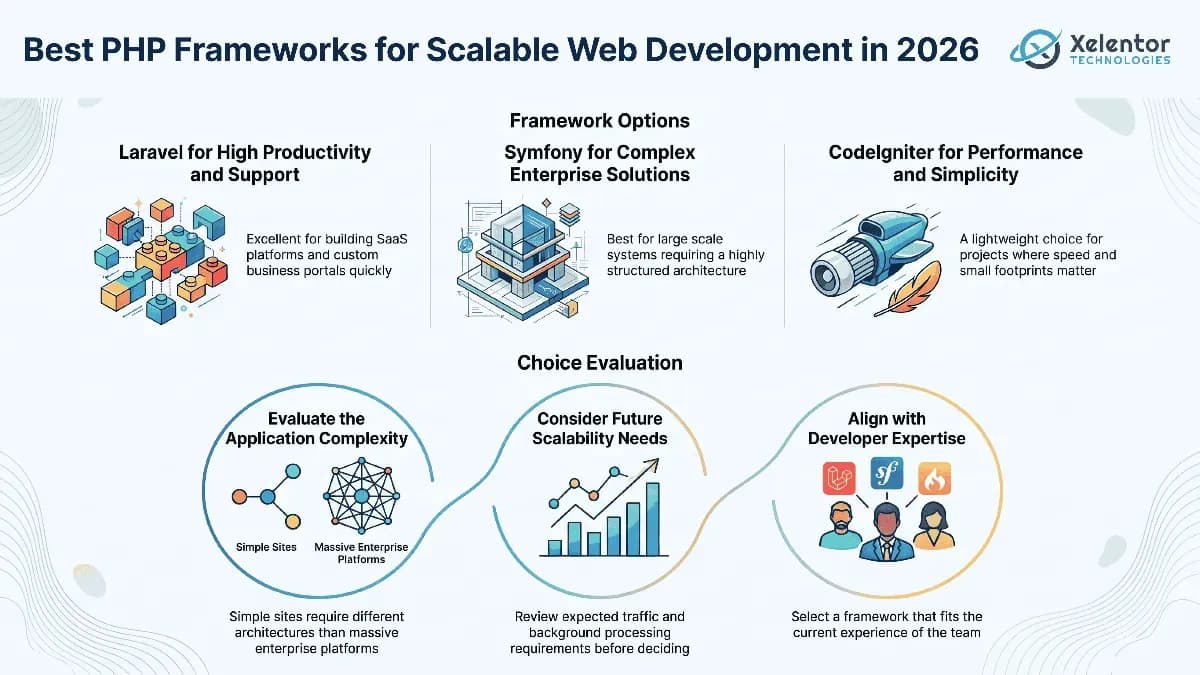
The best choice depends on your project. These three remain strong options.
1. Laravel
Laravel is one of the most popular PHP frameworks. It covers dependency injection, database abstraction, queues, scheduled jobs, migrations and testing and it works for full-stack applications as well as API backends. Its large ecosystem and developer-friendly design make it productive.
Best suited for:
- Business web applications
- SaaS platforms
- APIs
- ecommerce applications
- Customer portals
- Content management systems
- Custom web platforms
It is a strong choice when development speed, maintainability and ecosystem support matter most.
2. Symfony
Symfony suits complex and enterprise-level applications. It offers components for routing, dependency injection, databases, caching, security, messaging, validation and more and many of them can be used on their own in other PHP projects. That flexibility helps when an application needs a tightly structured design and heavy customization.
Best suited for:
- Enterprise applications
- Complex business systems
- Large-scale platforms
- API-driven applications
- Custom software solutions
- Applications requiring reusable components
3. CodeIgniter
CodeIgniter is known for being lightweight, fast and simple. It stays out of the developer's way and has a small footprint, which suits projects that value simplicity.
Best suited for:
- Lightweight web applications
- Small and medium-sized business applications
- Custom websites
- Performance-focused applications
- Projects where simplicity is important
For a new project, check the framework's current PHP requirements and supported versions first.
Laravel vs Symfony vs CodeIgniter
Laravel is usually the best fit when productivity, modern features and a rich ecosystem are the priority. Symfony tends to suit complex applications that need a strict structure and enterprise-level capability. CodeIgniter is a good option for teams that want a lighter framework with a simpler approach.
No framework is best for every application. Weigh the complexity of the application, the scale you expect, your developers' experience, integrations, security needs, hosting and long-term maintenance.
How to choose the right PHP framework in 2026?
Project complexity
A simple business app does not need the architecture of a large enterprise platform.
Scalability requirements
Think about expected traffic, database growth, background processing, API use and future features.
Development team expertise
Pick a framework your team already knows or one you have the time and budget to learn.
Security
Look at the framework's security features, how often it is updated and how active its community is.
Performance
Performance depends more on architecture, caching, database design and hosting than on the framework alone. Do not judge a framework by a benchmark in isolation.
Long-term maintenance
Documentation, community support, maturity and upgrade paths all affect how practical the framework stays as you grow.
Which PHP framework is best for scalable web applications?
For many modern business applications, Laravel is a strong starting point. Symfony can be the better fit for complex enterprise systems where architectural flexibility matters. CodeIgniter can suit projects where a light footprint and simplicity are the priority.
The best PHP framework depends on the application's business requirements, not on popularity.
Making the right framework choice
Do not ask which framework is best. Ask which one is the best fit for your application, your team, your scale and your long-term goals.
Pair the right framework with a solid architecture, an optimized database, secure development practices and reliable infrastructure and you have a strong base for scalable web development in 2026.
Frequently asked questions
Which PHP framework is best in 2026?
Laravel, Symfony and CodeIgniter are among the PHP frameworks worth considering in 2026. The best choice depends on the application's complexity, scalability requirements, development team, integrations, security needs and maintenance expectations.
Is Laravel suitable for scalable web applications?
Yes. Laravel provides tools for database management, dependency injection, queues, scheduled tasks, testing, APIs and other capabilities that can support modern and scalable web applications.
Is Symfony good for enterprise applications?
Yes. Symfony provides a broad set of components and capabilities covering security, databases, caching, messaging, testing, APIs, deployment and other areas that can be useful for complex enterprise applications.
Is CodeIgniter still relevant in 2026?
Yes. CodeIgniter 4 remains an actively documented PHP framework with a focus on lightweight development, performance, flexibility and security.
Which PHP framework should businesses choose?
Businesses should choose a framework based on project complexity, scalability, security, performance, development expertise, integrations, budget and long-term maintenance requirements rather than selecting a framework solely because it is popular.