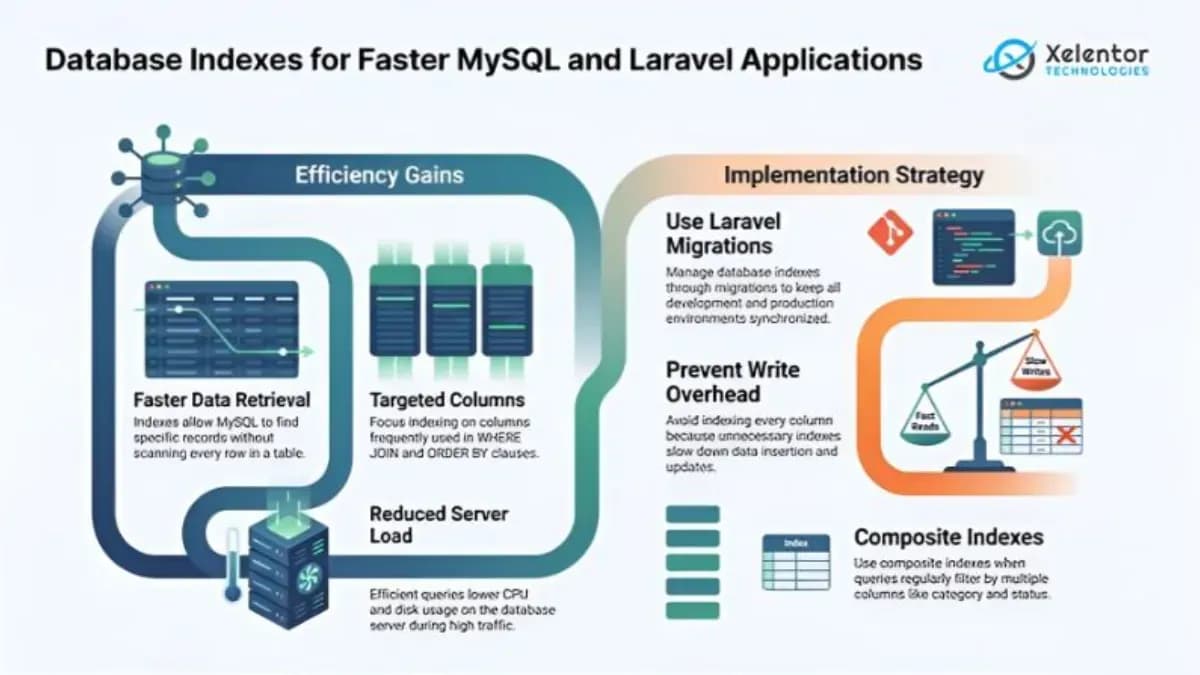
A Laravel application can feel fast with a hundred rows and crawl with a million. The code is the same. What changed is that the database now has to read far more data to answer each query and in most cases the cheapest fix is an index.
This guide explains what indexes are, how MySQL uses them, which types matter most in Laravel projects and the mistakes that cause trouble.
What are database indexes?
An index is a data structure that lets MySQL find rows without reading the whole table, like the index at the back of a book. When a query looks for a value, MySQL can jump straight to the matching rows.
Indexes help most on columns used in:
- WHERE clauses
- JOIN operations
- ORDER BY statements
- GROUP BY queries
- Foreign key relationships
Faster lookups also mean less CPU and disk work on the database server.
Why database indexes matter in Laravel applications?
Laravel makes database work easy through Eloquent and the Query Builder, but it does not make a slow query fast. If the table underneath has no suitable index, the framework just produces slow queries more conveniently.
Logins, product searches, order lists, dashboards and filtered API endpoints all depend on indexes. Take a login that looks up a user by email. Without an index on the email column MySQL may scan the whole users table for every login. With one it goes straight to the row. At a few thousand users nobody notices. At a few million, everybody does.
How MySQL processes queries?
MySQL reads your query, picks an execution plan and fetches the data. If no suitable index exists it performs a full table scan and reads every row to find matches. That is fine for a small table and increasingly costly as the data grows. An index lets MySQL examine far fewer rows.
Common types of MySQL indexes
Primary index
Created automatically for the primary key. In Laravel, the id column from a migration is already indexed this way.
Unique index
Makes sure every value in a column is different and speeds up lookups. It is the usual choice for emails and usernames.
Composite index
Covers several columns together. It helps when queries filter or sort on more than one column. An orders table, for example, often benefits from an index on customer_id and created_at when you list a customer's orders by date.
Foreign key index
Columns used in relationships should normally be indexed so joins stay fast.
Signs your Laravel application needs better indexing
- Pages that show filtered data load slowly
- Database CPU use is high
- API responses get slower as data grows
- Reports take longer and longer
- Complex queries time out
If you see these as your data grows, check your indexes before you buy bigger servers.
Best practices for MySQL and Laravel performance optimization
Index frequently queried columns
Focus on columns that show up in WHERE, JOIN, ORDER BY and GROUP BY. Indexing columns you rarely query costs storage and gains nothing.
Use Laravel migrations for index management
Define indexes in migrations so development, staging and production stay in step.
Avoid over-indexing
Every index makes INSERT, UPDATE and DELETE a little slower because MySQL has to maintain it. Add indexes on purpose, not on every column.
Analyze query performance
Use EXPLAIN to see how MySQL runs a query. It shows full table scans, inefficient joins and where an index would help.
Optimize Eloquent queries
Select only the columns you need, use eager loading to avoid repeated queries and paginate large results. Good queries and good indexes work together.
Example of index optimization in Laravel
Picture a product catalog where users filter by category and status. Without an index MySQL may scan thousands of rows for every search. A composite index on category and status lets it find the matches directly. Catalogs, SaaS apps and dashboards with constant filtering benefit the most.
Common indexing mistakes to avoid
Indexing every column
It wastes storage and slows writes. Index only where it measurably helps.
Ignoring composite query patterns
Separate indexes on single columns often lose to one composite index that matches how the query is actually written. Look at the real queries first.
Failing to review index usage
Query patterns change. Some indexes stop being used and new ones are needed. Review them from time to time.
Using indexes on very small tables
A table with a few dozen rows gains little from an index. Spend the effort where the data and the traffic are.
Database indexes and application scalability
Scaling is not only about more servers. A well-indexed database serves more traffic with fewer resources, which cuts server load and helps at peak times. For an application you expect to grow, getting indexing right early is far cheaper than a performance emergency later.
When to review database indexes
Review them whenever:
- A new feature adds complex queries
- Tables grow significantly
- API response times increase
- Reports slow down
- The database is under heavy load at peak times
A regular performance check keeps this from becoming a surprise.
Conclusion
Indexes are one of the cheapest and most effective ways to speed up a MySQL and Laravel application. The skill is knowing which ones to add: understand your query patterns, choose the right type and keep checking as the application changes. Done well, that means faster pages, lower infrastructure cost and an application that scales.
Frequently asked questions
What is a database index in MySQL?
A database index is a data structure that helps MySQL locate rows more efficiently, reducing query execution time and improving application performance.
How do database indexes improve Laravel performance?
Indexes allow MySQL to retrieve data faster for queries generated by Laravel's Eloquent ORM and Query Builder, resulting in quicker page loads, API responses and database operations.
Which columns should be indexed in Laravel applications?
Columns frequently used in WHERE clauses, JOIN operations, ORDER BY statements, GROUP BY queries and foreign key relationships are usually good candidates for indexing.
Can too many indexes slow down a database?
Yes. While indexes improve read performance, excessive indexing can increase storage usage and slow down INSERT, UPDATE and DELETE operations because MySQL must maintain the indexes whenever data changes.
What is a composite index in MySQL?
A composite index contains multiple columns in a single index and is useful for queries that filter or sort using more than one column, such as customer orders sorted by date.
How can I identify slow queries in Laravel?
You can use MySQL's EXPLAIN statement, Laravel query logging, performance monitoring tools and database profiling to identify inefficient queries and determine whether additional indexing is needed.