Companies are asked to ship faster, handle more users and stay online around the clock. Applications built the traditional way, as one large system on servers you manage, struggle with all three. That is why more businesses are building cloud native instead.
Unlike an application that is moved to the cloud later, a cloud native application is designed for the cloud from the start. This guide explains what that means, what you gain and what to watch for.
What are cloud native applications?
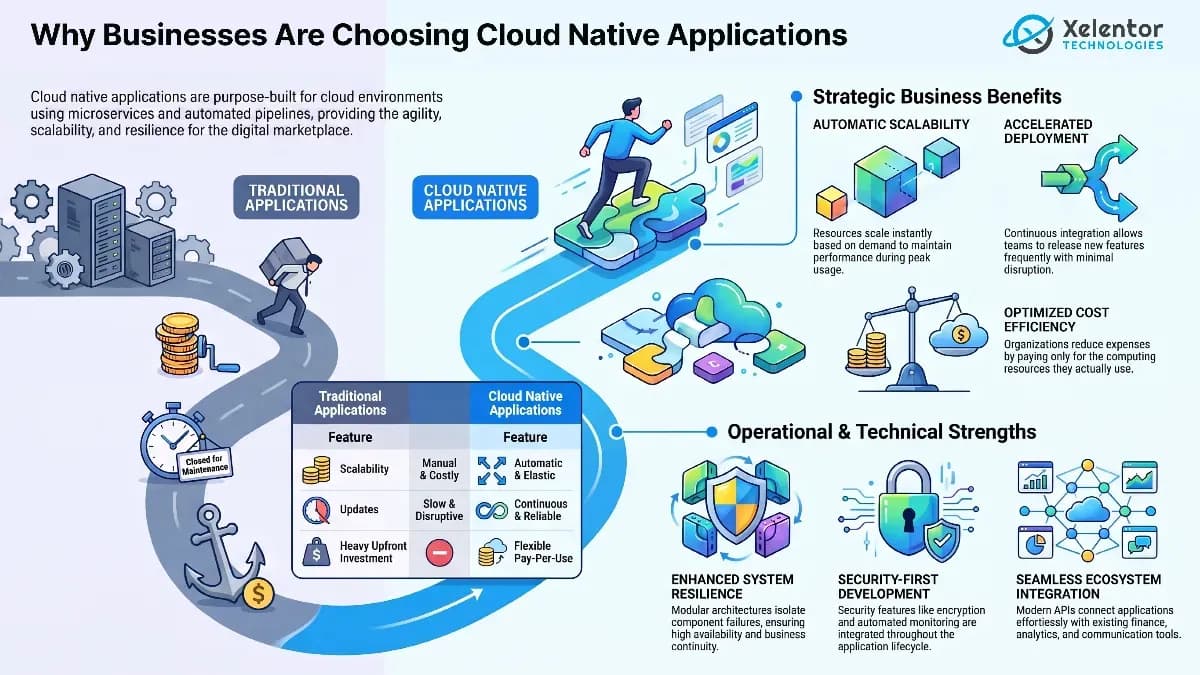
They are applications built to take full advantage of cloud platforms, using technologies such as microservices, containers, APIs and automated deployment. Each part can be updated, scaled or replaced on its own without touching the rest of the system.
That makes the software easier to change and lets it keep performing as demand shifts.
Why are businesses moving to cloud native applications?
The short answer is agility. Customer expectations keep changing and cloud native design lets a business respond to the market, reduce operational complexity and release new features faster.
Improved scalability
Traffic and data grow and some businesses see big seasonal peaks. A traditional system often needs a hardware upgrade to cope. A cloud native application scales with demand and uses resources efficiently, so you get performance at the peak without paying for it all year.
Faster software development and deployment
Cloud native development goes hand in hand with continuous integration and deployment. Teams ship smaller updates more often with less disruption, which shortens the time from idea to customer.
Enhanced reliability and availability
Downtime costs revenue and trust. Cloud native applications are built to keep running when one component fails and a modular design keeps a fault in one area from taking down the whole system.
Better cost efficiency
You pay for the computing you use instead of buying hardware for the peak. Resources can adjust automatically, which lowers infrastructure cost over time.
Stronger security
Security is built into each stage of development, not added at the end. Cloud platforms also provide identity management, encryption and automated monitoring, which help protect sensitive data and meet compliance needs.
Integration with modern business systems
Cloud native applications are built to connect to other systems through APIs. That means better data sharing, fewer manual steps and a connected set of tools.
Supporting digital transformation
Transformation is about changing how you work, not just buying new tools. A cloud native platform gives you the agility to build, release and scale quickly and it makes it easier to add analytics, automation and AI later.
Challenges to consider
Cloud native is not free of effort. You need to look at your existing technology, set clear goals and make sure your team has the skills. Migration, architecture design, security and ongoing management all need planning and an experienced partner can help.
Best practices for cloud native application development
Start with a clear business goal. Use a modular design so parts can scale on their own. Automate building, testing and deployment. Monitor continuously and keep the platform updated. And pick technologies that fit what you need today and still make sense as you grow.
Conclusion
Cloud native applications give a business scale, flexibility, reliability and speed. For companies investing in digital growth they are a strong foundation, provided the move is planned with clear goals and a team that knows the platform.
Frequently asked questions
What are cloud native applications?
Cloud native applications are software applications designed specifically for cloud environments using technologies such as microservices, containers, APIs and automated deployment pipelines.
Why are businesses adopting cloud native applications?
Businesses are adopting cloud native applications because they improve scalability, accelerate software delivery, enhance security, reduce infrastructure costs and support digital transformation initiatives.
What are the benefits of cloud native application development?
Cloud native application development provides faster deployment, improved reliability, better scalability, enhanced security, straightforward integration and greater operational efficiency.
Are cloud native applications suitable for small businesses?
Yes. Cloud native applications help businesses of all sizes reduce infrastructure costs, improve flexibility and scale technology as their operations grow.
How do cloud native applications support digital transformation?
Cloud native applications enable organizations to modernize legacy systems, automate business processes, improve collaboration and build scalable digital solutions that support long-term growth.