Most companies run a surprising number of systems: a CRM, accounting software, a payment provider, an inventory tool, a marketing platform. The real work is getting them to share data without people copying it between screens.
There are two common ways to do it, API integration and point-to-point integration. Both work. They differ in how well they cope as you add more systems and that is what this guide helps you weigh.
What is API integration?
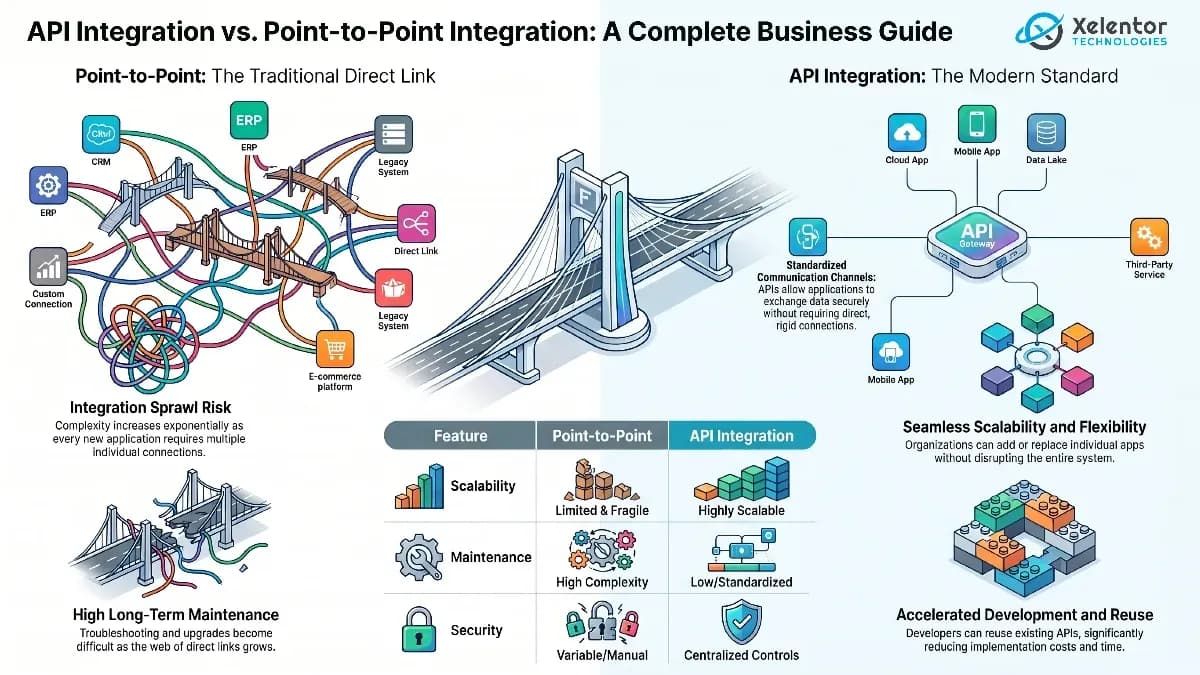
API integration connects applications through Application Programming Interfaces, which are standard channels that let one system request or send data to another securely. Instead of building a separate link between every pair of systems, each one exposes an API and the others use it.
That makes integrations reusable and easier to extend and it is why APIs underpin cloud applications, mobile apps, SaaS products and most enterprise software today. Businesses commonly use them to connect:
- Customer Relationship Management (CRM) systems
- Enterprise Resource Planning (ERP) software
- Payment gateways
- Inventory management systems
- Marketing automation platforms
- Customer support applications
- Business intelligence tools
Done well, API integration improves data accuracy, removes manual work and gives you a more connected business.
A small example from our own work is a call billing platform that captures call time from Zoom and Microsoft Teams and pushes invoices to Xero, so nobody retypes anything. You can read about it in the call billing platform case study.
Benefits of API integration
Improved scalability
When you add an application you connect it to the API and do not redo the existing links.
Better flexibility
You can replace one application without breaking the rest of the integration setup.
Enhanced security
Modern APIs include authentication, authorization, encryption and access controls.
Faster development
Developers reuse existing APIs instead of building each integration from scratch, which saves time and cost.
Easier maintenance
Standard methods are simpler to maintain than a web of one-off connections.
What is point-to-point integration?
In point-to-point integration two applications talk to each other directly through a dedicated connection. Every new application needs its own connection to each system it exchanges data with.
That looks fine at first. With five applications you may already need around ten separate connections to build and maintain and the number climbs quickly with every addition. It suits small environments, but many businesses now run dozens of connected tools.
Benefits of point-to-point integration
It still has its place in a few situations.
Simple initial implementation
Connecting two applications directly is often quicker than designing a wider integration approach.
Lower initial investment
With only a few systems, it can cost less to start.
Direct communication
Data goes straight from one system to the other with no layer in between, which keeps simple cases simple.
For a small setup with minimal needs it can deliver acceptable results in the short term.
Why point-to-point integration becomes difficult to manage
Businesses keep adding customer platforms, cloud services, analytics tools and finance systems and each one needs business data. With point-to-point links, every addition means another connection to build, monitor and maintain. Over time that causes:
- A complicated integration architecture
- Higher maintenance costs
- More time spent troubleshooting
- Greater security risk
- Harder software upgrades
- Less room for future growth
This is often called integration sprawl: the connections become harder to manage than the applications. Many companies only act once they realize they are maintaining dozens of direct links that nobody fully understands.
API integration vs point-to-point integration
| Factor | API integration | Point-to-point integration |
|---|---|---|
| Connections | Shared, reusable interfaces | One direct link for each pair of systems |
| Scalability | New systems connect without rebuilding existing links | Connections multiply as systems are added |
| Maintenance | Changes happen in one place | Every link is maintained separately |
| Security | Central authentication and access control | Controls repeated on each connection |
| Flexibility | A system can be replaced with limited impact | Replacing a system affects every link to it |
| Initial effort | More design work up front | Quick for two systems |
Which is the best choice?
For most growing businesses, API integration is the better long-term choice. It keeps integrations reusable, secure and easier to maintain as new applications are added.
Point-to-point integration can still make sense when only two or three stable systems need to share data and the connection is unlikely to change. Even then, it helps to plan how those connections could move to an API-based approach later.
Conclusion
The right integration approach depends on how many systems you run today and how many you expect to add. Point-to-point links are quick to start but grow harder to manage with every new application. API integration takes more design work at the start and gives businesses a foundation that scales.
Frequently asked questions
What is the difference between API integration and point-to-point integration?
API integration uses standardized interfaces to connect multiple applications, making integrations scalable and easier to maintain. Point-to-point integration creates direct connections between systems, which can become complex as the number of applications grows.
Which is better: API integration or point-to-point integration?
API integration is generally the better choice for growing businesses because it offers greater scalability, flexibility, security and easier maintenance. Point-to-point integration is more suitable for small environments with only a few connected systems.
When should a business choose API integration?
Businesses should choose API integration when they need to connect multiple applications, support future growth, improve data sharing or build a modern digital ecosystem.
What are the disadvantages of point-to-point integration?
Point-to-point integration can become difficult to manage as more systems are added. It often results in higher maintenance costs, increased complexity, limited scalability and more challenging troubleshooting.
How does API integration support digital transformation?
API integration enables reliable communication between business applications, automates workflows, improves data accessibility and allows organizations to adopt new technologies more efficiently.