Most software projects that go wrong do not fail on the code. They fail on the things around it: goals that were never written down, requirements that changed without anyone agreeing, updates that stopped arriving and problems nobody raised until they were large.
Good execution is mostly discipline. This guide covers the habits that keep a project on course, whether you run it yourself or hand it to a partner.
What is software project execution?
It is the work of turning a plan into working software by coordinating people, processes and tools. It covers far more than development: clarifying requirements, planning sprints, managing tasks, testing, talking to stakeholders, handling risk, preparing for release and checking performance afterward.
Why effective project execution matters?
Software projects juggle several teams, shifting requirements, outside integrations and tight deadlines. Without structure, even a good plan runs into trouble. Strong execution also keeps technical and non-technical people on the same page, which prevents the misunderstandings that cause most delays and rework.
Establish clear project objectives
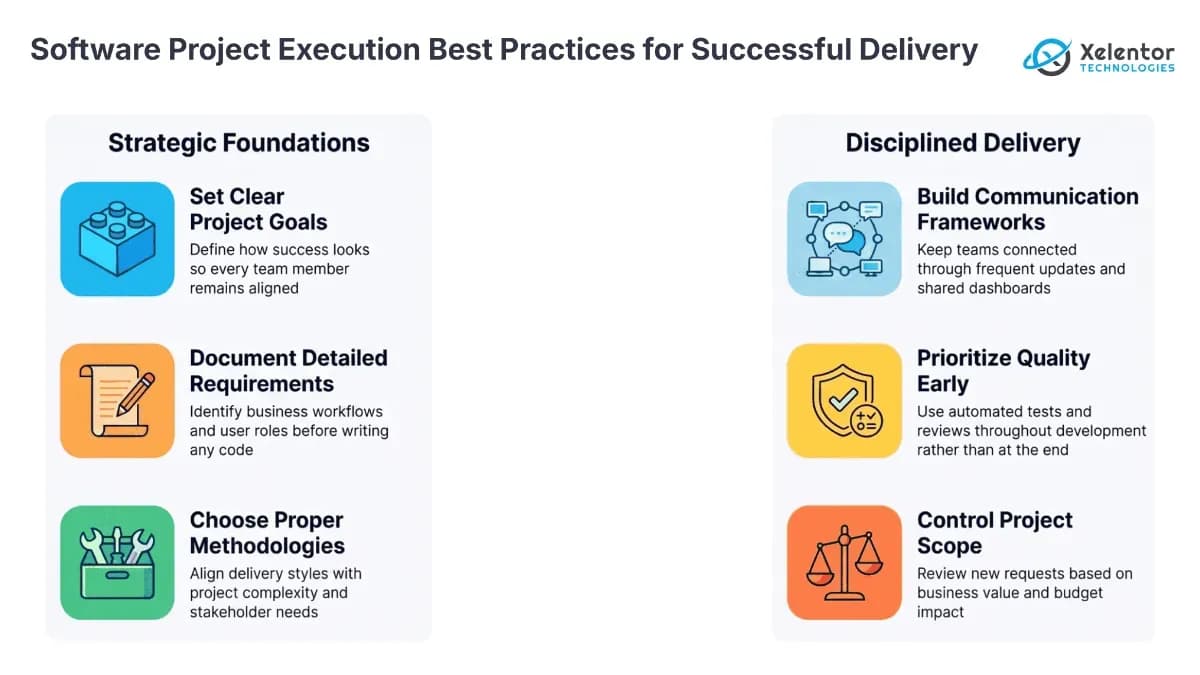
Everyone should be able to say what the project is for, which problem it solves and how you will know it worked. Make the goals specific and measurable. Vague goals lead to arguments about whether the work is finished.
Define requirements thoroughly
Unclear requirements are one of the most common causes of failure. Before building starts, spend time on what the software must do, who uses it, what it connects to and what it must never do. Agile lets requirements evolve, but a solid starting point still saves expensive changes later.
Choose the right development methodology
Agile suits projects that need steady delivery, feedback and room to change. Many projects work best with a mix: agile delivery in short cycles plus enough planning and documentation to keep control. Pick the method that fits the size and risk of the project, not the one that is fashionable.
Build a strong communication framework
Developers, testers, designers, product owners and project managers all need to stay aligned. The basics work well: regular status meetings, a demo at the end of each sprint, a shared task tracker, written decisions and a clear route for escalating problems. Visible progress helps teams spot trouble early.
It matters even more for distributed teams, where time zones and distance make silence easy.
Manage scope carefully
Scope creep happens a little at a time. A new request here, a shifted priority there and the project has grown beyond its budget. Use a simple change process: for each request, ask what it is worth, what it costs in effort and what it does to the timeline. A prioritized backlog keeps the most valuable work first.
Prioritize quality throughout development
Testing is not a phase at the end. Code reviews, automated tests, integration and performance testing and security checks should run alongside development. Finding a defect in the week it was written is far cheaper than finding it after launch. For business-critical applications this protects customer trust.
Monitor progress with meaningful metrics
Use data and not impressions. Useful measures include work completed against plan, the time it takes to finish a task, defects found and fixed and how often releases go out. Reviewing them regularly lets you adjust early when something slips.
Identify and mitigate risks early
Every project carries technical, resource and business risks, such as a key person leaving, an integration that behaves differently than documented or a dependency on a third party. Keep a short risk list, give each risk an owner and review it every week or two.
Encourage cross-functional collaboration
Developers, testers, designers, DevOps engineers and analysts should work together from the start, not hand work over a wall. It speeds up decisions, cuts handoff delays and keeps the solution aligned with what users need.
Prepare for deployment early
Many projects slip in the last week because nobody planned the release. Start early on environments, the deployment pipeline, backups and recovery, monitoring, security hardening, user training and acceptance testing. A well-prepared release is quiet.
Conduct post-project reviews
Going live is not the end. Ask what worked, what did not and what you would change. Write the answers down so the next project starts from what you learned.
On our own projects a delivery lead owns the plan, the risks and the reporting and the client can join sprint demos and code reviews. That is the same list of habits applied in practice.
Conclusion
Clear goals, solid requirements, honest communication, firm scope control, steady testing, early attention to risk and a planned release are what make projects succeed. Treat execution as a discipline and not as an afterthought and software gets delivered on time, within budget and for the purpose it was built.
Frequently asked questions
What is software project execution?
Software project execution is the process of implementing the project plan by coordinating development, testing, communication, resources and delivery activities to build and deploy a software solution successfully.
Why is software project execution important?
Effective project execution helps ensure that software projects are delivered on time, within budget, meet quality standards, reduce operational risks and align with business objectives.
What are the key factors for successful software project execution?
Key factors include clear objectives, detailed requirements, effective communication, disciplined scope management, continuous testing, progress monitoring, risk management and strong cross-functional collaboration.
How can Agile improve software project execution?
Agile improves project execution by enabling iterative delivery, continuous stakeholder feedback, faster issue resolution, better adaptability to changing requirements and improved visibility into project progress.
What is scope creep in software projects?
Scope creep occurs when additional features or requirements are added to a project without proper evaluation of their impact on timeline, budget, resources and overall project objectives.