Each wave of tools has changed how developers work. Better editors made coding easier, cloud platforms changed deployment and DevOps brought development and operations closer. AI coding tools are the next change and Claude Code, an agentic coding tool from Anthropic, is one of the best known.
The question for teams in 2026 is not whether to use tools like this. It is how they change the workflow and where human engineering still matters most.
What is Claude Code?
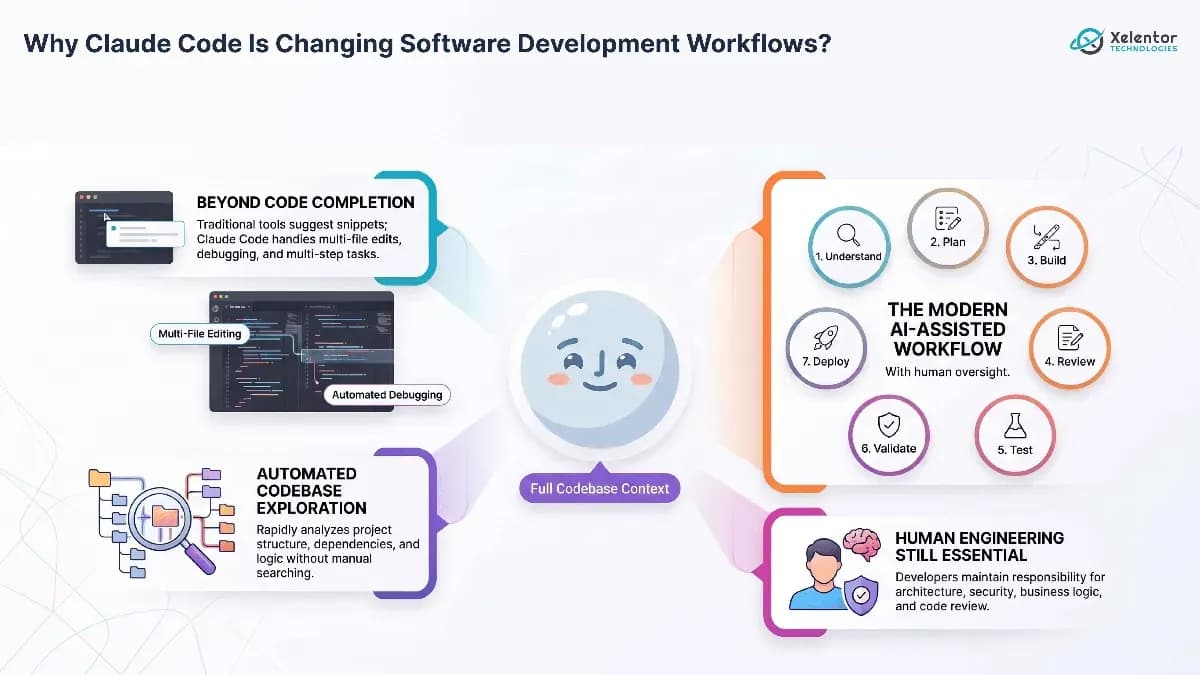
Claude Code is an agentic coding tool that works directly inside a software project. Older AI assistants mostly suggested the next line or turned a prompt into a snippet. An agentic tool goes further. It can read across many files, understand the wider context, make coordinated changes, run commands and adjust based on the result.
So a developer can ask it to investigate a bug, not just write a function. It looks through the relevant code, proposes causes, suggests or makes a fix and helps check it.
How Claude Code is changing software development
Understanding existing codebases
Getting to know an unfamiliar codebase takes real time. A developer can ask where authentication is handled or which parts depend on a given API and get a starting point in seconds. It does not replace understanding the architecture. It shortens the search.
Moving beyond code generation
Writing code is a small part of the job. Developers also read, debug, change, test and review. Instead of asking for a function, they can describe a goal, such as adding a capability to the existing application and listing what has to change. The work shifts from producing snippets to carrying out tasks inside a real project.
Faster debugging and problem investigation
Debugging means reading several files, following data and trying fixes. An agent can speed up that search. A developer still has to confirm that the cause and the fix are correct. AI speeds up the investigation. It does not remove the need for testing.
Supporting code refactoring
Large applications collect technical debt. AI can help spot repeated patterns, simplify functions and restructure components. Every automated change still needs a careful review, because something that looks right can affect performance, security or business logic elsewhere.
Improving testing workflows
After a feature is built, AI can draft unit tests and suggest edge cases that were missed. Generated tests are a good start. They are not proof of quality, which still depends on understanding user needs and business risk.
Supporting code reviews
AI makes a useful extra reviewer. It can catch errors and inconsistencies before a human looks. People still catch what AI misses, such as product priorities, architecture direction and security context. The strongest setup is AI-assisted review combined with experienced judgment.
Helping with documentation
Documentation falls behind because features come first. AI can draft explanations of modules, APIs and changes and it helps new developers learn an undocumented area. Someone still has to check that the text matches what the code does.
Claude Code and developer productivity
The main gain is not typing speed. It is less time spent on repetitive and information-heavy work: searching, reading, preparing tests, tracking down bugs and writing docs. That leaves more time for architecture, product decisions, security and hard problems. The developer's role does not disappear. It changes.
Does Claude Code replace software developers?
No. Software engineering is about more than producing code. Someone has to decide why a system is built, how people will use it, which architecture suits it and how data is protected.
AI can produce a valid implementation that is wrong for the business need. People remain responsible for requirements, review, security and for making sure the software does what it should. The more capable the tools become, the more valuable good technical oversight is.
Risks businesses should consider
- Code quality. AI code can look right and hide subtle problems. Every meaningful change needs review and testing.
- Security. Know what project information goes to AI tools and keep credentials and secrets out of it.
- Overreliance. Accepting changes nobody understands creates technical debt and makes later maintenance harder.
- Missing context. AI does not know your business rules unless they are written down, so clear documentation and standards still matter.
Claude Code in enterprise development
For a business the value depends on how the tool fits into the engineering process. Teams need to decide which repositories AI can access, how generated code is reviewed, how sensitive data is protected and what testing is required before release. The goal is not more code. It is a better development process.
Building an AI-assisted development workflow
- Understand. Use AI to explore the codebase and gather context.
- Plan. Decide what has to change before any code is generated.
- Build. Let the tool help with implementation.
- Review. Engineers check the changes and their wider impact.
- Test. Run automated and manual tests.
- Validate. Confirm the result meets the real business need.
- Deploy. Release through your normal DevOps process.
This is close to how we work on dedicated teams. Code, tests and documentation start as AI drafts, while architecture, security and every merge stay with a senior engineer.
The changing role of software developers
Writing code still matters, but developers now spend more of their time guiding AI, checking its work and understanding the wider system. Problem solving, architecture, security awareness, testing and understanding the business become more valuable when implementation gets faster.
The opportunity for software companies is not just faster coding. It is a process where AI and experienced engineers work together to deliver software that is reliable and easy to maintain.
Frequently asked questions
What is Claude Code?
Claude Code is Anthropic's agentic coding tool that helps developers work with codebases, implement changes, investigate issues, run development tasks and support software engineering workflows.
Is Claude Code only for writing code?
No. It can support tasks such as understanding codebases, debugging, refactoring, testing, documentation and other development activities.
Can Claude Code replace developers?
AI coding tools can automate or accelerate parts of software development, but developers remain important for requirements, architecture, security, validation, testing and technical decision making.
Can businesses use Claude Code for existing software projects?
Yes. Agentic coding tools can be particularly useful for understanding and working with existing codebases, although organizations should establish appropriate security, access, testing and review practices.
What is the main benefit of AI-assisted software development?
The main benefit is the potential to reduce repetitive engineering work and accelerate tasks such as code exploration, implementation, debugging, testing and documentation while keeping developers responsible for technical quality.