Growth puts pressure on engineering. The roadmap gets longer faster than the team can build it. Hiring takes longer than planned. The people you have are splitting their week between fixing old problems, shipping new features and keeping the lights on.
That is usually the moment a leader asks the question: do we hire our own team or bring in a dedicated one?
The answer affects more than recruitment. It shapes how fast you ship, how easily you can change direction and how much management time the work takes. This guide compares the two models in plain terms so you can choose for the stage your company is at now.
What is a dedicated development team?
A dedicated development team is a group of engineers assigned to your product and nobody else's. Unlike traditional outsourcing, where a vendor takes a task and hands back a result, the team works as an extension of yours. They join your stand-ups, follow your priorities and stay on the product as it grows.
A team can include some or all of these roles:
- Software developers
- QA engineers
- UI/UX designers
- DevOps specialists
- A delivery lead or project manager
- Business analysts
The mix depends on your product and your timeline. The biggest advantage for most growing companies is speed. You skip the job ads, the interviews and the notice periods. You start with people who have done this kind of work before.
What is an in-house development team?
An in-house team is made up of employees you hire directly. They work inside your processes and your culture. They carry the product knowledge in their heads for as long as they stay.
An in-house team gives you:
- Direct day-to-day oversight
- Close collaboration with the rest of the company
- Strong long-term ownership of the product
- Technical skills that stay inside the business
If software is the core of what you sell, building your own engineering organization pays off over the long run. It also takes real investment in recruiting, onboarding, equipment, retention, management and training. For a company that needs to move fast, those costs can slow things down before the team has written much code.
Dedicated development team vs in-house team: key differences
Either model can work well. The better one depends on how quickly you need to move, scale and adapt.
Speed of scaling
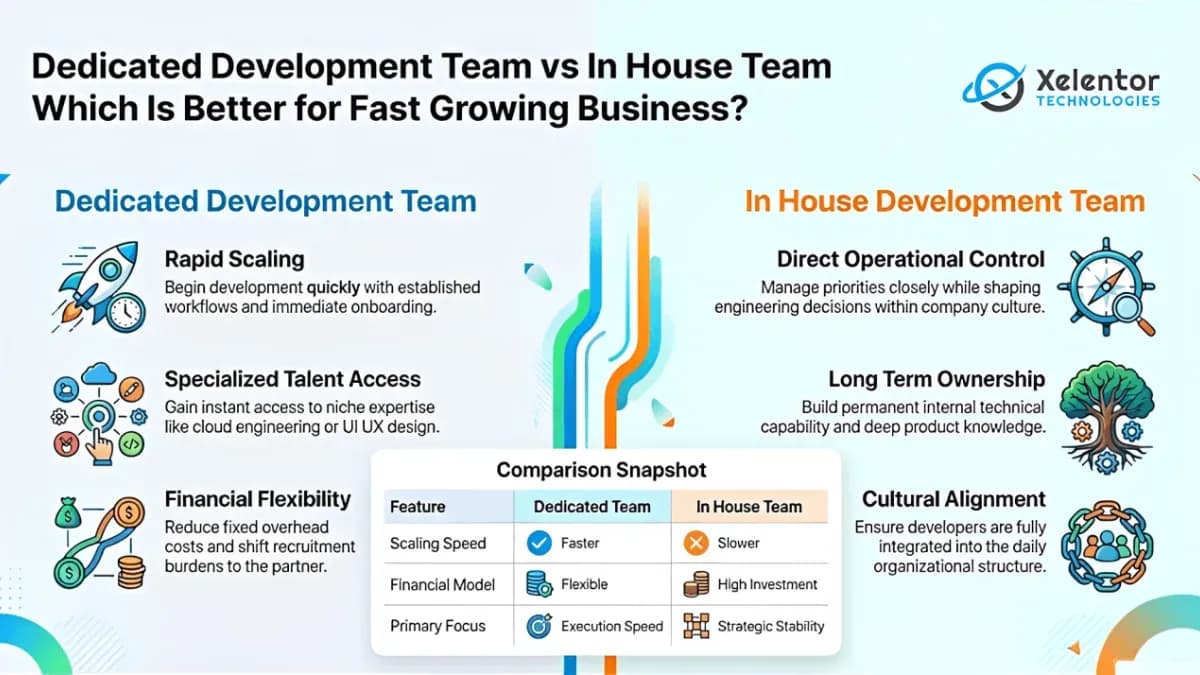
The most practical difference is how soon work can begin. An in-house hire means writing the role, finding candidates, interviewing, negotiating, onboarding and setting up workflows. That often takes months.
With a dedicated team the sourcing and setup are already done. You review the engineers, meet them before they start and begin once you approve them. For a start-up launching a product or a SaaS company trying to keep up with demand, that gap can decide whether you hit the window.
Speed to market is often worth more than the short-term saving of hiring slowly.
Cost structure and financial flexibility
Many companies assume hiring is the cheaper route. A salary is only part of the cost. You also pay for recruitment, benefits, payroll taxes, hardware and software, office space, management time and training. Then you carry all of it whether the roadmap is busy or quiet.
A dedicated team turns most of that into one monthly invoice. It is not always cheaper. But it is far easier to scale up for a launch and scale down after a release. For a growing company that flexibility often matters as much as the price.
Access to specialized technical talent
One product can need a backend architect, a cloud engineer, a mobile developer, a designer and a QA automation engineer, all in the same quarter. Hiring each of those takes time. Some you may only need for a few months.
A dedicated team gives you access to those skills much sooner. That matters most when the timeline is tight and the technical needs keep changing.
Management and operational control
This is where an in-house team has a real edge. Leadership sits next to the engineers, sets priorities directly and shapes how the team works day to day.
A dedicated team can integrate well, but it depends on a few things being in place:
- A clear way to communicate
- Visibility into progress
- Agreed processes for planning and review
- A named owner for each area
The best dedicated partnerships feel like an embedded product team, not an outside vendor. In practice that means a delivery lead who owns planning, risks and reporting, demos at the end of each sprint and code reviews you can join. If you cannot see the work, you do not have a dedicated team. You have a contractor.
When a dedicated development team makes more sense
A dedicated team is usually the better choice when you need to move quickly and scale efficiently. It tends to fit when:
- Product development needs to speed up
- Your internal engineers are stretched thin
- Hiring would slow you down
- The roadmap is growing fast
- You need to scale the team up and down
- You need a specialist skill quickly
In each case the aim is the same: close the gap between what the product needs and what your engineers can deliver.
When an in-house team can be the better choice
An in-house team is usually stronger when software is a permanent strategic capability and not a scaling problem. It tends to fit when:
- Software is central to how the business runs
- Engineers need to work with other departments every day
- You are building up your own technical leadership
- Long-term ownership of the product is the top priority
- Your hiring timeline and budget are manageable
For a mature product company, internal engineering skill can become a lasting advantage.
How fast-growing businesses should decide
The right choice depends on your priorities and your stage, not only on budget. These questions help.
How quickly does the team need to scale?
If the deadlines are urgent, a dedicated team will usually get you moving sooner.
How complex is the product?
Complex products need several specialist skills at once, which are slow to hire one by one.
Is internal technical leadership already established?
A dedicated team works best when you already know the product direction and priorities. If you do not, settle them first.
Is operational flexibility important?
If your priorities change often, engineering capacity that can grow or shrink with them is very valuable.
Is this a short-term scaling need or a long-term strategic function?
This one often settles it. A temporary spike points to a dedicated team. A permanent core capability points to hiring your own.
It does not have to be one or the other. For a large staffing provider in Australia and New Zealand we worked alongside the client's own delivery team of 15 or more developers and testers, fixing and extending the parts of their platform that were holding it back. You can read how in the workforce platform case study.
Common mistakes businesses make when choosing a team model
Most wrong choices come from looking only at the cost this quarter instead of the ability to deliver over the next year.
- Hiring too early without product clarity. Building a large internal team before priorities are settled adds cost with nothing clear to build.
- Focusing only on short-term savings. The cheaper option does not always deliver better.
- Underestimating recruitment time. Finding experienced engineers usually takes longer than expected.
- Ignoring delivery speed. A slow hiring process can cost you market opportunities.
- Not planning for scale. The team you choose should still fit six to twelve months from now, not just today.
Final thoughts
There is no universal answer. Both models work when they match the strategy.
- A dedicated team is usually ideal when speed, flexibility and fast scaling matter most.
- An in-house team is usually better when long-term ownership and internal skill are the priority.
For a fast-growing company the best choice is rarely the cheapest one. It is the model that lets you deliver sooner and keep growing without a stall in the middle.
Frequently asked questions
Is a dedicated development team cheaper than hiring in-house?
A dedicated development team often reduces fixed hiring overhead, but overall cost depends on project scope, scaling requirements and delivery timelines.
When should businesses choose dedicated developers?
Dedicated developers are often the right choice when businesses need faster scaling, specialized expertise or additional delivery capacity without lengthy recruitment cycles.
Is an in-house development team better for long-term products?
In many cases, yes. When software becomes a long-term strategic asset, internal engineering capability can provide stronger product ownership and operational continuity.
Can dedicated developers work like an internal team?
Yes. With proper collaboration processes and communication structure, dedicated developers can function as an extension of your internal team.