AI is changing custom software in two separate ways. It changes how software gets built, because developers now work with AI assistants. And it changes what software can do, because applications can read documents, answer questions and spot patterns.
The two get mixed up in most articles on this topic. This guide keeps them apart, shows where each one pays off and covers the problems to plan for.
What is AI in custom software development?
It means using AI techniques such as machine learning, natural language processing, computer vision and generative AI in two places: in the tools developers use to build software and in the software itself.
Traditional software follows instructions someone wrote in advance. AI-powered features can analyze data, recognize patterns and make predictions, so an application can do things like read an invoice, summarize a case file or recommend a next step.
On the development side, AI tools help write code, find bugs, draft tests and review changes. They speed up routine work. They do not replace the engineers who decide how the system should be built.
Why businesses are integrating AI into software development?
The reasons are practical. Software projects are bigger, release cycles are shorter and customers expect more. AI helps teams:
- Build faster and reach the market sooner
- Catch problems earlier through automated analysis and testing
- Automate repetitive work for staff and customers
- Offer personalized experiences
- Watch applications for unusual behavior
- Reduce long-term maintenance effort
Key benefits of AI in custom software development
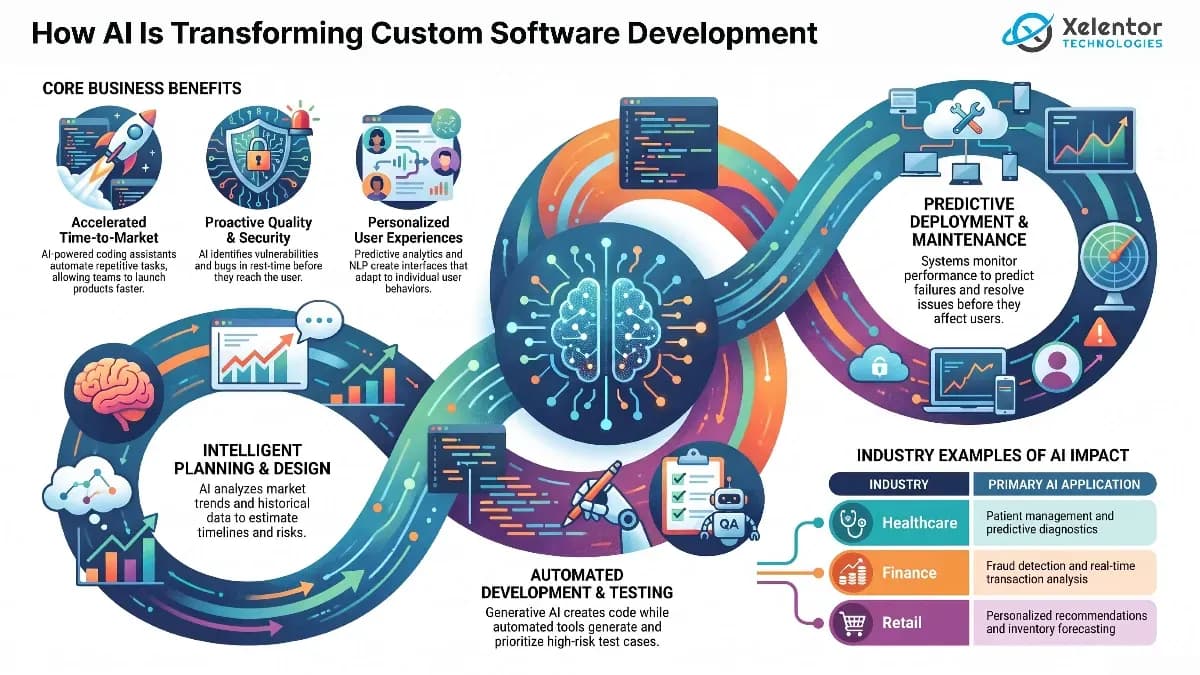
Faster development
Coding assistants suggest code, handle repetitive tasks and flag errors as developers type. Engineers spend less time on boilerplate and more on the parts that need judgment.
Better quality and testing
AI can generate test cases, point to the riskiest areas and review code for common mistakes. That finds defects before release, when they are cheapest to fix.
Smarter use of data
AI can spot trends in business data, forecast demand and highlight what needs attention, so decisions rest on evidence and not on guesses.
A better user experience
Recommendations, assistants and chatbots make an application easier to use and more helpful, which tends to improve engagement and retention.
Automation of routine work
Invoice processing, document handling, support triage and similar tasks can run largely on their own, which frees people for work that needs a human.
Stronger security and room to grow
AI can monitor systems for unusual activity and well-built AI features keep improving as they see more data. Both help software keep up with the business.
AI technologies powering modern software development
- Machine learning finds patterns in past data. It is used for fraud detection, recommendations, predictive maintenance and forecasting.
- Natural language processing lets software understand and respond to human language. It powers chatbots, intelligent search and automated support.
- Computer vision lets software interpret images and video, for quality inspection, document scanning and security.
- Predictive analytics combines statistics and AI to forecast sales, stock levels and customer churn.
- Generative AI drafts code, documentation, interfaces and test cases and it can answer questions about your own documents.
AI across the software development lifecycle
Project planning and requirement analysis
AI can help summarize requirements, flag gaps and compare similar past projects, which makes estimates more realistic.
Design and development
Assistants suggest code, explain unfamiliar areas and propose design improvements. Developers still make the architecture and security calls.
Software testing
Test cases can be drafted alongside each feature, so tests get written even when deadlines are tight.
Deployment and maintenance
After release AI can watch performance and flag unusual activity so teams find problems before users do.
This is how we work on dedicated teams. Code, tests and documentation start as AI drafts and architecture, security and every merge stay with a senior engineer. Used that way it speeds work up without lowering the bar.
Real-world applications of AI in custom software development
- Healthcare: scheduling, document processing and administrative support for care teams.
- Finance: fraud detection, risk checks and customer support.
- Retail and ecommerce: recommendations, demand forecasting and service chatbots.
- Manufacturing: predictive maintenance, quality control and production monitoring.
- Logistics: route planning, shipment tracking and warehouse management.
Challenges of implementing AI in software development
Data quality. AI is only as good as the data it works from. Messy or incomplete data gives unreliable results.
Legacy systems. Older software often cannot supply data or accept AI features without modernization first.
Privacy and security. AI applications handle sensitive information, so access controls and compliance need to be designed in from the start.
Skills. Good results need people who understand software engineering, cloud and machine learning together.
Best practices for successful AI integration
- Start with a business problem. Pick something specific that AI can solve, not AI for its own sake.
- Choose high-impact use cases. Aim for results you can measure, such as hours saved or faster responses.
- Keep humans in control. Review important outputs and decisions.
- Prepare your data. Clean, accessible data matters more than the choice of model.
- Start small. Prove one use case before you spread AI across the product.
The future of AI in custom software development
Expect AI assistants to take on more of the routine work in coding, documentation and testing and expect more software to ship with built-in assistants and automation. The human work shifts toward deciding what to build and checking that it is right.
Companies that learn to use AI well now will find it easier to keep improving their products later.
Frequently asked questions
What is AI in custom software development?
AI in custom software development refers to integrating technologies such as machine learning, natural language processing, computer vision and predictive analytics into software applications and development processes. It helps automate tasks, improve decision-making, enhance software quality and deliver personalized user experiences.
Can AI replace software developers?
No. AI is designed to support developers, not replace them. While AI automates repetitive tasks such as code suggestions, testing and debugging, experienced software developers remain essential for architecture design, strategic planning, innovation and solving complex business problems.
What are the biggest benefits of AI in software development?
The major benefits include faster development cycles, improved software quality, automated testing, stronger cybersecurity, intelligent business automation, better data-driven decision-making, personalized user experiences and reduced operational costs.
Which industries benefit the most from AI-powered custom software?
Healthcare, finance, retail, manufacturing, logistics, education, real estate, insurance and ecommerce are among the industries that benefit significantly from AI-powered software through automation, predictive analytics, operational efficiency and enhanced customer engagement.
How do I choose the right AI software development company?
Look for a technology partner with proven expertise in AI, custom software development, cloud technologies, cybersecurity and industry-specific solutions. Review their portfolio, technical capabilities, development process and ability to deliver scalable, secure and business-focused software tailored to your requirements.